For Leo of Rome

They say that as he stood before
Attila, angels by his side,
The force of truth and all the church
Sent the violent host away.
They say the angel’s sword gleamed bright;
They say Attila ran in fright;
They say, they say so many things,
And many things have gone astray.

Another story, firm in print,
Tells of the words he spoke before
The flailing church, the force of truth
Deep within his words.
Some spoke, some spoke against the truth,
Some fled far from the Gospel’s proof;
Many said so many things,
And many words had led astray

But Leo, firm at Ephesus,
Though there his words were all ignored,
Firm again at Chalcedon,
His words heard there, a clarion call,
Declared the truth they had forgot,
The truth of Christ, both man and God;
His words, though few, revived the truth
That has not gone away.

Communion (For Saints, Martyrs, Missionaries and Teachers of the Anglican Communion)

The stories are told of the many who died;
Some of them rest in the Abbey.
The bricks there stand firm over hundreds of years;
But some stories fade with the passing.
The pillars still hold but the truth, sometimes shaky,
Whispers and shudders through ages,
For the towers we built and the books that we wrote
May still stand in their shells while eroding.

We hold to this name, from a time and a place
When the soil was red with the anguish
Of the battles decided and conflicts now closed,
With the truth stifled in its own history.
The name and the place both matter far less than
The heart of the battles we fought there.
While the ones clothed in white all gather to wait,
Will they find us still living their story?

Experiments in Form Part 4: Playing with the Sonnet

One of the interesting results of playing with form is that the nature and structure of the form begins to dictate, or at least direct, some of where the poem goes. This makes it a great creative exercise: you may not know what to write, but once you begin, the form starts to help shape the poem. Now, this can be a good thing but it can also mean that you end up writing something that borders on nonsense. The art, I suppose, is in working with the form – allowing it to give fuel to the process without taking over.

A conversation today about the way that French composer and pianist Claude Debussy worked with harmonies, developing something of a precursor to jazz, inspired me to spend some time tonight listening to Debussy, and prompted this new experiment in the Spenserian sonnet form. Working with an almost impressionistic composer, a handful of slightly surreal images and a fixed rhyming scheme and meter was always bound to produce something interesting, even if it failed to be especially good. I’ll let you judge the quality for yourselves.

Spenserian Sonnet No. 2: For Debussy

Look: by the moon’s light silver chords are dancing,
In their soft and steady moonsteps rising,
Fleet feet rising in the night, entrancing,
Drooping silver by the dark horizon,
All the bells and streams of night surprising
Silent ears and all the trees’ ash towers,
Every stardrop of the night comprising
All the promises of night’s soft hours.
And the waiting moon has its own countries
Where the chords drift in its shadow bowers,
Gently oceans washing its rough frontiers;
Soft as every cloud, you listen, singing
To the heavens of the night still ringing.

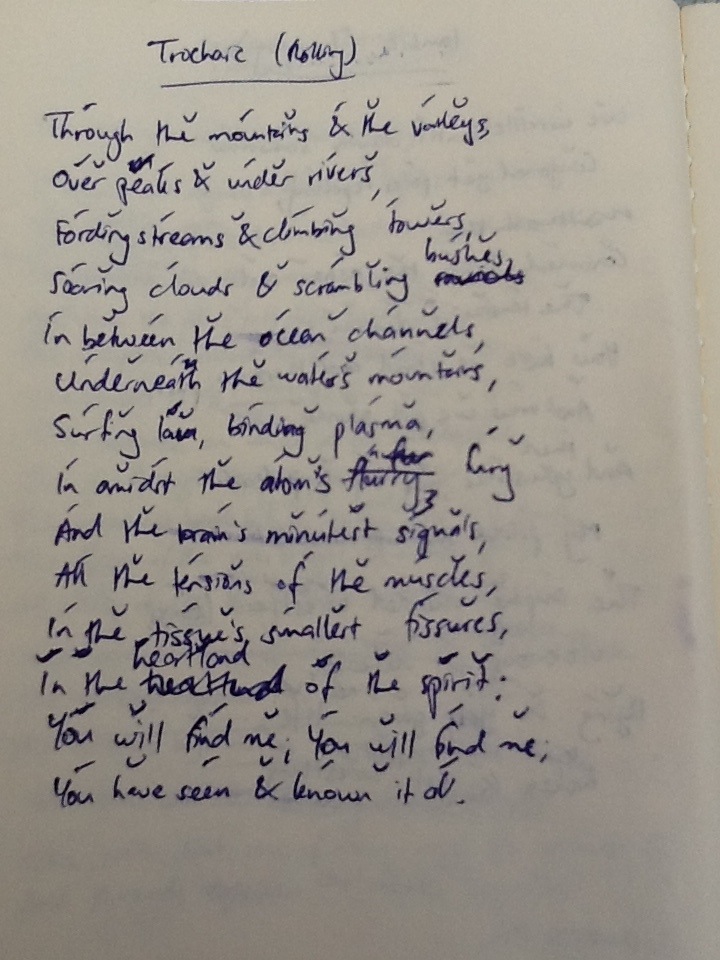
Experiments in Form Part 4: Rolling

The second of the two poetic feet, the trochee, is much less common than the iambic foot. Iambic meter is more like regular speech; trochaic meter is much stronger, more emphatic. It means “rolling”, and you can see why. The stress should naturally fall on the first of every pair of beats, and creates a driving, pounding rhythm, like a stone rolling down a hill.

Rolling (Trochaic Foot)

Through the mountains and the valleys,
Over peaks and under rivers,
Fording streams and climbing towers,
Soaring clouds and scrambling bushes,
In between the ocean’s channels,
Underneath the water’s mountains,
Surfing lava, binding plasma,
In amidst the atom’s fury,
And the brain’s minutest signals,
All the tension of the muscles,
In the tissue’s smallest fissures,
In the heartland of the spirit:
You will find me, You will find me;
You have made and known it all.

20121106-152023.jpg

Experiments in Form Part 3: The Spenserian Sonnet

Of the three major sonnet forms, I have found the Spenserian to be the nicest to write in. Like the Petrarchan sonnet it contains only five rhymes (the Shakespearean has seven) and the rhyming scheme is elegant, with a lovely motion to it, like a series of interlinking circles, rounded off with the rhyming couplet that it shares with the Shakespearean sonnet. The trick, I suppose, is to select the form that best matches the content you are writing. Each form has its strengths and weaknesses. But I have most enjoyed writing in the Spenserian form. Here is what I produced.

Spenserian Sonnet

The rain, you see, is not our enemy:
It breaks our dryness, dances in the light;
Its sparkles quell the sun’s bright enmity,
With softness soothing summer’s blinding sight.
And when the glare sets dying fields alight,
Our unexpected friend the rain descends,
The comfort of its cleansing setting right
The balance on which all our life depends.
Though through each day we don’t know how it ends –
This movement back and forth through night and day
– The father of the rain and light, he mends
All daily dying things in his soft way,
The rain but one of many ways he weaves
And threads our woes together with reprieves.

Experiments in Form Part 2: The Petrarchan Sonnet

The most common, and probably the most popular, of the traditional poetic forms is the sonnet. However, there are three main types of sonnet – the English/Shakespearean, the Italian/Petrarchan and the Spenserian. Until Saturday I had never written a sonnet; my first attempt, entitled “The See-Saw”, was written in the form of a Shakespearean sonnet and was posted here on Saturday night. Yesterday I tried my hand at a Petrarchan sonnet, and am posting the result here.

The Petrarchan sonnet is slightly more difficult than the Shakespearean. The rhyming scheme is more varied and challenging, and the first stanza (eight lines = octave) poses the problem of each bracket of four lines containing, in its middle, a rhyming couplet which, when handled badly, can sound clumsily repetitive. The alternating rhymes of the Shakespearean sonnet feel more subtle, and the closing couplet gives the poem an emphatic conclusion. The Petrarchan sonnet requires a defter touch to achieve that same balance of subtlety and emphasis. Here is my by-no-means deft first attempt at the form.

Petrarchan Sonnet

You cry in silence and your cries fall dead;
The walls betray your best attempts to rise
Out of yourself and make peace with the skies,
Each anxious prayer a layer in your head.
Only, beneath these layers lie instead
The awkward truth, naked and undisguised:
True motivations, all the things unsaid.

The truest tears are humble and don’t lie;
They do not dress themselves in fine attire.
They open up, give names to each desire,
Both pure and corrupt, the jumbled mess,
In Heaven’s care to sort and answer why,
Our only task to cry out and confess.

Experiments in Form Part 1: Limping

Some recent conversations with friends, along with a handful of other influences – skimming, for instance, the last book of essays published by the late Peter Steel, then picking up his last book of poems just today – have got me thinking about poetic form, about the vast range of forms out there which have kept poetry vital and inventive for a long time, many of which are largely neglected by contemporary poets. Why is this? When T.S. Eliot and Ezra Pound used free verse, it was a social statement, a rejection of an artistic order which no longer reflected the fragmentation of post-war reality. But even Eliot, after his conversion to Christianity, began to write more ordered, traditional poetry; and many today are starting to see that, if all we have is fragmentation, life is not much fun and does not make terribly much sense. Perhaps we are starting to see that form is not all that bad; perhaps we can see that form, in its place, can be helpful.

At the very least, I have been thinking increasingly about the value in form as a means of both creative challenge and artistic discipline. Working in a variety of forms forces me to improve as a writer, to increase my versatility, much in the way that an athlete works on their strength, fitness and flexibility and a musician works on their range.

And so you can expect to see me posting here some experiments with different poetic forms, both structurally and rhythmically. Today’s experiment is rhythmic. There are four types of poetic “feet” that can be used, and I am going to practise writing in each one, to see both how it is done and what effect it has.

My first experiment is in the most famous and, for me, the most familiar and comfortable of the feet – the iambic foot. “Iambic” actually means “limping”, and so I am playing with that idea in this poem. At its best, form always complements meaning, so today’s poem is a slightly literal investigation into how that works.

Limping

We wrestle until dawn, somehow
Conjoined yet poles repelling,
Consumed within the action and
The tension of division:

How here we stand and there we push
And now we pull asunder,
And then you strike my hip and tear
My pride out of its socket;

The limping, wounded wrestler leaves,
Victorious, yet defeated,
Dying, and yet given new life,
Broken and yet still wrestling.

I am including here the handwritten version of the poem for those interested in seeing the creative process. The symbols above the words indicate the unstressed beats (breve, indicated with a loop) and the stressed beats (indicated with an accent).
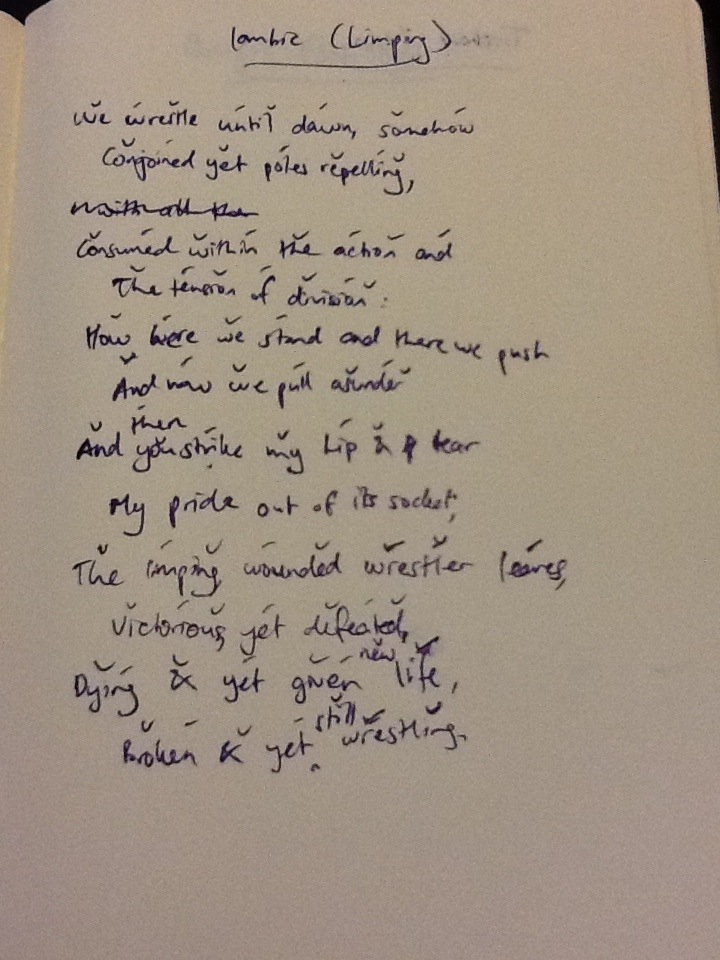
20121105-195340.jpg

Cleave (Twenty-Third Sunday After Pentecost)

Then Orphah kissed her mother-in-law good-bye, but Ruth clung to her.
(Ruth 1:14)

Many and wide are the roads you may take,
Bitter and sweet is the journey;
Many the gods you may may bow down before,
Legion the altars to worship.

Blessed the path that’s hardest to take,
Sweetest the fruit with most poison;
Many the laws and many commands;
Few there are who can obey them.

Simple the path but lifelong the death
That they die, those who choose to walk it;
Simple the choice and single the Lord,
But many the sirens who beckon.

Rich is the grace and vast are the hands
That hold all sojourners within them;
Paid is the cost and firm is the end,
Demanding your all and all giving.

The See-Saw: A Sonnet

The motion pulls us this way and that, astride
A swaying plank of ever moving force,
And how we go, how you and I both ride
The gambit and the sure and certain course
Is now to trust and now to hold our arms
Beside our sides as slowly we both bend,
Though never safe yet always far from harm,
The only certainty that this will end.
Now up, now down, the movement takes us all
In dips and troughs and soaring heights, to trees;
There’s special providence in sparrows’ fall
And quantum joy within the rushing breeze;
And by the see-saw’s side our Father stands,
Gently reaching with His shaking hands.

The Law of Limits (For Richard Hooker, Theologian)

Law…is bound up with the compatible variety of things in the universe…In creating, God chooses to make a world of limits – that’s what creation is; his purpose being to secure the greatest possible variety of imitations of his own being, a complex of realities each…’participating’, sharing in his own being in a unique.
(Rowan Williams, The Richard Hooker Lecture, October 2005)
Finite made from infinite,
The space for life to flourish, yet
The ceiling and the walls contain
The place for quiet, rich submission,
Pregnant with the fullness of
Life and what it is to be
Made inside the image of
One beyond imagination.
So kings wear crowns and bishops mitres,
Churches have walls and floors;
Spirits are contained in bodies,
Yet the Body grows beyond its comprehension.
History is time and place
And story bursting inside walls
And quiet, rich submission in
The boundaries of vast creation.