Advent with the Prophet Jonah: Day 4

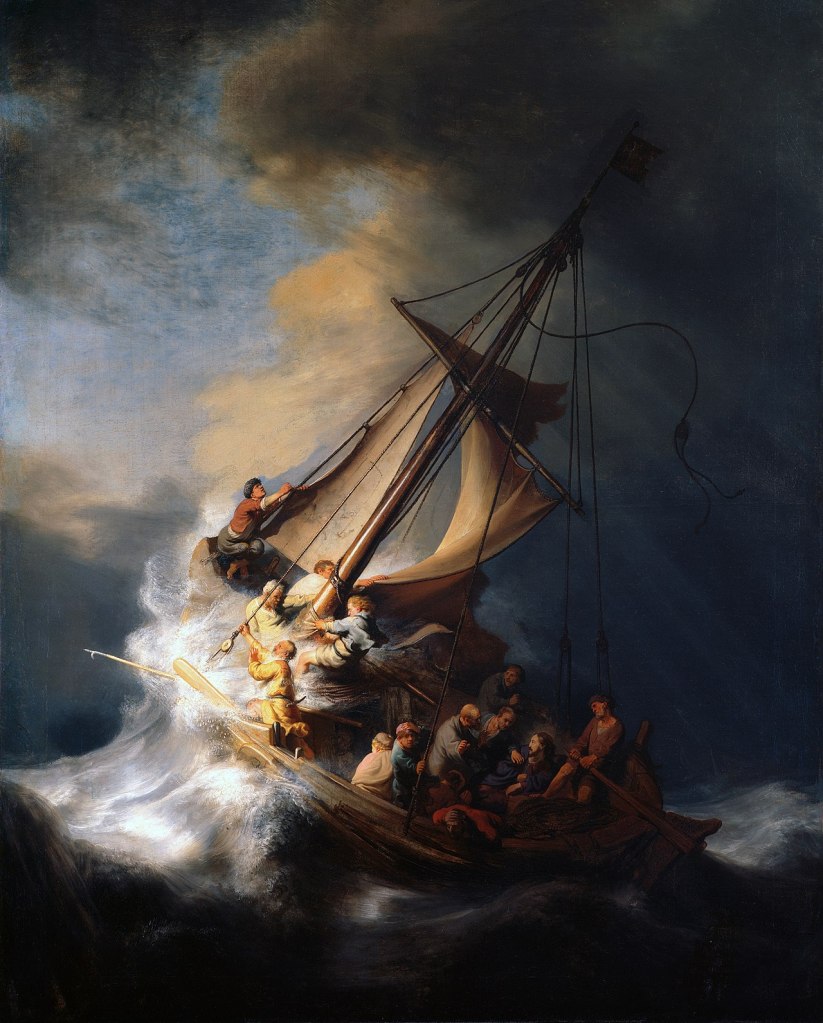
Rembrandt van Rijn, “Christ in the Storm on the Lake of Galilee”

Then the sailors said to each other, “Come, let us cast lots to find out who is responsible for this calamity.” They cast lots and the lot fell on Jonah. So they asked him, “Tell us, who is responsible for making all this trouble for us? What kind of work do you do? Where do you come from? What is your country? From what people are you?”

He answered, “I am a Hebrew and I worship the Lord, the God of heaven, who made the sea and the dry land.”

This terrified them and they asked, “What have you done?” (They knew he was running away from the Lord, because he had already told them so.)

The sea was getting rougher and rougher. So they asked him, “What should we do to you to make the sea calm down for us?”

“Pick me up and throw me into the sea,” he replied, “and it will become calm. I know that it is my fault that this great storm has come upon you.”

(Jonah 1:7-12)

The first thing that Jonah admits to is that he is defined by relationship with God – and not just with the god of his people but with the “God who made the sea and the dry land”. Most ancient religions had different gods for the sea and the land. The sea was associated with a chaos that needed to be subdued in order for dry land and human life to exist. Other gods managed the harvest, the storm, war, peace. Jonah’s God is a God of unity, and of everything. He cannot pick and choose which bits of his life he allows God to rule. And he cannot defy God and expect the world to be unaffected.

As anger turns us inward, it can create the illusion that we are worlds unto ourselves. We can try to ignore the impact that our anger has on others, and we can also ignore our responsibilities to others that continue even while we are raging internally. Jonah, a prophet, is called to be God’s messenger. He has refused one opportunity to be that messenger for Nineveh, and here, on the boat, he is failing to be that messenger to the others on the boat. In a book filled with irony, another irony appears here: that the others on the boat show greater reverence for Jonah’s God than he does. Compare this with Paul, who used violent storms at sea as opportunities to share God’s message with his companions on the boat. Compare this even with the fearful disciples who knew that shaking Jesus awake could rescue them from the storm. Jonah’s response is much more the one I must admit that I am inclined towards: an inward-focused denial of my responsibility to others as a person of God.

The turning point for Jonah is to accept responsibility – to recognise that his disobedience to God has not just been a matter between him and God but between him and others, even him and creation. The earth is impacted by our sin, and so are our relationships. And when we rage against God, we make ourselves gods of our own little, internal kingdoms, failing to see the storms that we have made around us and the lives that are threatened by our failure to pay attention.

The answer? Stop ignoring the storm. Enter the storm. Because the God of sea and dry land will be there in the storm, waiting for you to speak to Him.
Advent with the Prophet Jonah Day 3

Then the Lord sent a great wind on the sea, and such a violent storm arose that the ship threatened to break up. All the sailors were afraid and each cried out to his own god. And they threw the cargo into the sea to lighten the ship.

But Jonah had gone below deck, where he lay down and fell into a deep sleep. The captain went to him and said, “How can you sleep? Get up and call on your god! Maybe he will take notice of us so that we will not perish.”

(Jonah 1:4-6)

Why is Jonah asleep? Often I’ve heard Biblical stories like this interpreted to demonstrate complacency or obliviousness: Jonah is asleep because he is not paying attention, spiritually dull. Perhaps this is the case. But, when I think of myself, I often go to sleep – physically or metaphorically – when I don’t want to talk to God. And often this is because I am angry, and I know that to talk to God I will need to let go of at least some of my anger. I can’t maintain all of my rage and also do the self-humbling that is necessary to pray. I know God well enough to not let loose with all my fury, but I’m not ready to unclench my fists enough to fold my hands in prayer.

It’s a guess, but an educated one, to suggest that this might be where Jonah is at here in the story. Certainly it fits with the Jonah we see later, angry enough to die because God has relented and not destroyed Nineveh like he hoped. Jonah knows, I’m sure, that he should have followed God’s command; he knows he shouldn’t be on this boat; he knows he is in the wrong. But he doesn’t want to think about it, because thinking about it would require humbling himself, and he’s not ready to do that. So he sleeps.

It strikes me how often I clench my fists in stress, as though I am ready to start punching at the first moment that it’s required of me. We cannot talk to God when we are like this, not properly. To talk to God, we need to stretch our fingers out, let go of our pent-up rage, and let Him be God while we are children before Him. Sometimes we even need to physically open our hands up before Him as an expression that we are ready to receive from Him whatever He has. But even this is humbling. Attention to God is humbling when all we want to do is listen to our own pre-recorded loops of internal rage.

Like Jonah, we need to be shaken awake and told, sometimes by the least expected of people, to stop hiding from God, huddled in our own fury, and to turn to Him instead – to turn in humility and wait.

Advent with the prophet Jonah: Day 2

The word of the Lord came to Jonah son of Amittai: “Go to the great city of Nineveh and preach against it, because its wickedness has come up before me.”

But Jonah ran away from the Lord and headed for Tarshish. He went down to Joppa, where he found a ship bound for that port. After paying the fare, he went aboard and sailed for Tarshish to flee from the Lord.

Jonah 1:1-3

The book of Jonah begins with a prophet refusing his divine mission and going the opposite way. Growing up I always understood this to be because he was lazy or contrary or just plain disobedient. Most likely he didn’t want to see his enemies repent and be saved. You see, the detail in God’s message for Jonah that we often miss is that God is choosing to warn Nineveh ahead of time, and He would only do that if He wanted to give them a chance to change their fate. This is precisely what Jonah, an Israelite threatened by the growing Assyrian Empire, doesn’t want the Assyrians to get: a chance to change. Like so many of us, Jonah wants God to be merciful but on his terms not God’s. And like so many of us Jonah doesn’t see that the very thing he resists is the very thing that can save him: God’s mercy to the least deserving.

There’s another irony in what Jonah decides to do. In sending an Israelite prophet to another country, God is showing that He isn’t some local deity with strict parish boundaries but the God of all people. And in resistance to this Jonah tries to run away – to where? Away from God? Away from His mercy?

I am like Jonah because I want God to act on my terms. I am like him because I want a mercy for myself that I do not dispense to others. I am like Jonah because, in refusing to be a bearer of mercy to others, I fail to experience it fully myself. And this is the root of anger.

If indeed anger has a single root. In my experience it feels more like a rhizome, sending out shoots in many, tangled directions until it is nearly impossible to remove. Perhaps it isn’t for me to uproot. Perhaps, like Jonah, I just need to stop and listen, or stop and be: to listen to the word of mercy God has given, and to be a person shaped by that mercy.

Advent is about expectancy – expecting God to act in saving us. But that expectancy has to begin with us reorienting our expectations to align with Him. And so we stop running and we listen to what God has to say.

The Rage of Being Flesh: Advent with the prophet Jonah

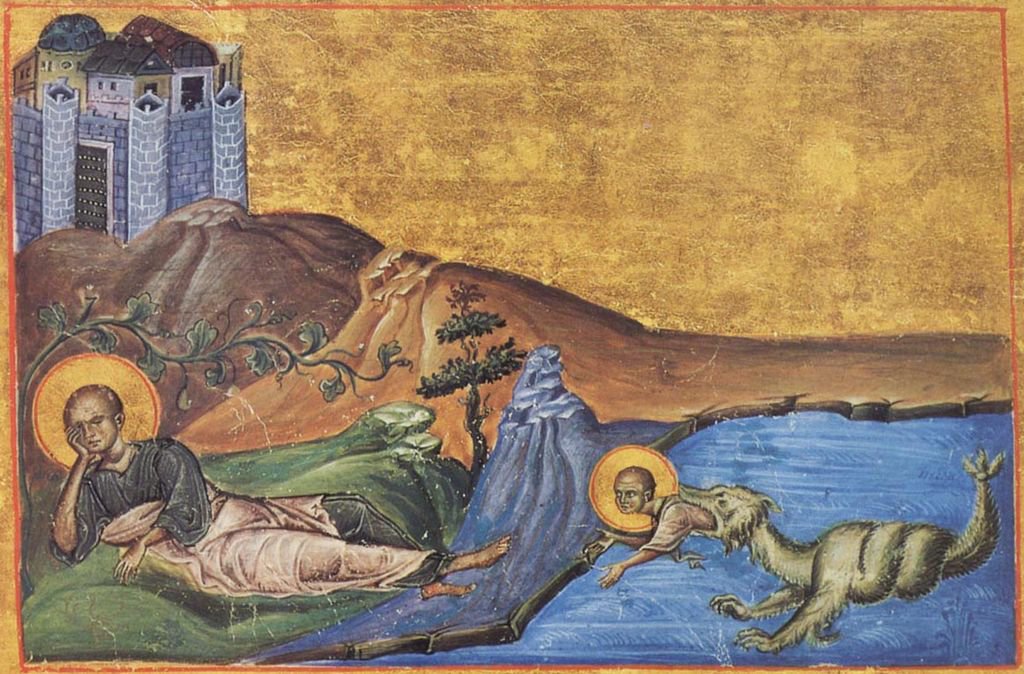
Icon of the prophet Jonah from the Menologion of Basil II, 11th century

But God said to Jonah, “Do you have a right to be angry about the vine?” “I do,” he said. “I am angry enough to die.”
(Jonah 4:9)

Advent devotionals do not usually start here, with the prophet Jonah angrily beneath his vine, wanting to see Ninevah destroyed and his vine restored. But I’m beginning here this year for two reasons. The first is that I am angry, much of the time, and I know that 2020 has made many people angry, so for Advent to transform us this year we might need to enter it just as we are and watch to see what God does to change us. The second is that, like Jonah, I often miss what God is really doing, and how it saves me and the world, because I am too busy raging over what I want Him to be doing instead. And so I enter this Advent as Jonah, wanting to do what God wants yet torn apart by my own rage and the way it blinds me to the truth of God-with-us.

I am also struck by the ways that anger points to Advent. It may not seem so at first, but we are so often angered by the now and not yet of life, by the glory and the goodness we feel we should be living in – that we feel is our right – and the many ways in which reality does not conform to our expectations, though we see glimmers of it everywhere. In every day there are signs of God-transfiguring glory – vines that burst out of nowhere to give us shade; grace that pulls us out of the whale’s belly and into – what? Everyday obedience. Hot sun that wearies us. And the dull, humiliating necessity of loving our enemies. The anger that simmers or explodes at these daily realities can, if viewed through the prism of Advent, be found to reveal our deepest longings and the agony that comes from them being thwarted each day. At the heart of this is the truth for which God created us and which He is redeeming in the world even now.

Are we right to be angry? No, I for one am not, most of the time. But the things that make me angry, whether righteous or not, can tell me much about how I expect the world to be, and consequently what I expect God to do for me. Some of the reasons for my anger reveal the things that I know are not right in this world and that need to be made right. Others point to that which is not right in me. All this I must bring to God in Advent, so I can speak truthfully to Him in the darkness of waiting and let His Spirit speak to me. I must sit with Jonah and God and let Him ask us both, Are you right to be angry? And then I must stop and listen to what He has to say next.

Will you join me and Jonah this Advent and listen too?

Poem after a line from Auden

Prayer, like poetry, makes nothing happen,
if "make" means control
and "happen" means an instant, an event.
No incantations with prayer, no spells;
nor with poems. You leave
scratching your head,
ambivalent to what has transpired.
Sometimes forced, sometimes fluid,
never simple, unless void of all
meaning save the surface.
But prayer and poems both deal in depths;
they refuse surface and befuddle the hurried.
And poems, like prayers, work
with more than words,
sometimes in spite of them:
the conversation between words and rhythm,
movement and meaning,
soul and maker,
music in words
that moves hearts with fingerprints
always unseen.

Excerpt from “Plague Year”

But we venture on. Newness at least is in
the air, on Capitol Hill, in the fruit 
jumping out of trees. We cannot slow this
if we wanted to. Shopping aisles charge on
towards Christmas, while my heart craves Advent.
I could use the dark, the waiting, to bend
soul's joints back into shape, could use the long
silence to learn again to wait, to wish.
We have not yet traced the evil to the root,
nor will we. But our hearts may learn to sing
a purer song if they remember this:
the days we could not sing or hug or kiss,
the days we passed at home craving our home
where we are not apart and not alone.

The Gospel Reading

The day had gone on long enough.
First the Pharisees and their questions,
then the intruding children,
then the camel and the needle's eye,

so that, when they cried out,
"Who then can be saved?" it was
as much from the weariness of the day's
debates as the thought that riches
could keep an earnest man from heaven.

And so, right when
all their careworn sandles seemed
not worth the effort, He looked
into eyes and said, "What's impossible
for man is possible for God."
What then? Could God lift
the labour-sick soul, and write
new possibility on its nature?

In the midst of the burden
and the striving, this truth:
Be small. Be like a child.
Be less so I may be more.