2025 in books

When I was in Year 7, we were required to read thirty books as part of a “general reading” assessment in English. Each week we would go to the library, log the books we had read, and either our teacher or the librarian would quiz us on the books to confirm we had read them. Although I had been a voracious reader when I was younger, I remember finding reading hard at that time. My appetite was for books that were more mature than I was and I bored easily. But my family also made fun of me forever changing books so I developed a strategy of simply claiming to have finished a book when I hadn’t. Occasionally a book would grab my attention for long enough that I would hyperfocus on it and devour it until it was gone. But mostly this was rare, and would be until I reached an age when the books that matched my reading level also matched my emotional development.

So in year 7 I fudged my way through the year of general reading, logging books I had barely skimmed, and trading on the trust my teachers had in me as a “good student” to make it through the cursory questions I received on my reading. Most of the time I logged so many books that they couldn’t be bothered quizzing me. When they professed amazement at my rate of reading, I probably seemed modest, but really I was embarrassed. I didn’t want the attention. I just wanted to be left alone.

This year I started using a new app to log my reading, and at any given moment I have around ten books or more listed as “currently reading”. Most of the time I have at least one novel, one book of poetry and one or more devotional or theological books on the go. When I say that I read 160 books this year, I need to assure you that, unlike my 12-year-old self, I’m telling the truth. But many were poetry books (meaning, short), a few were graphic novels, and lots were novellas (meaning, short). My attention still wanes easily, though now I have a diagnosis to explain that. But I am constantly in a book; I’ve just learnt how to move between the vicissitudes of my fickle attention span.

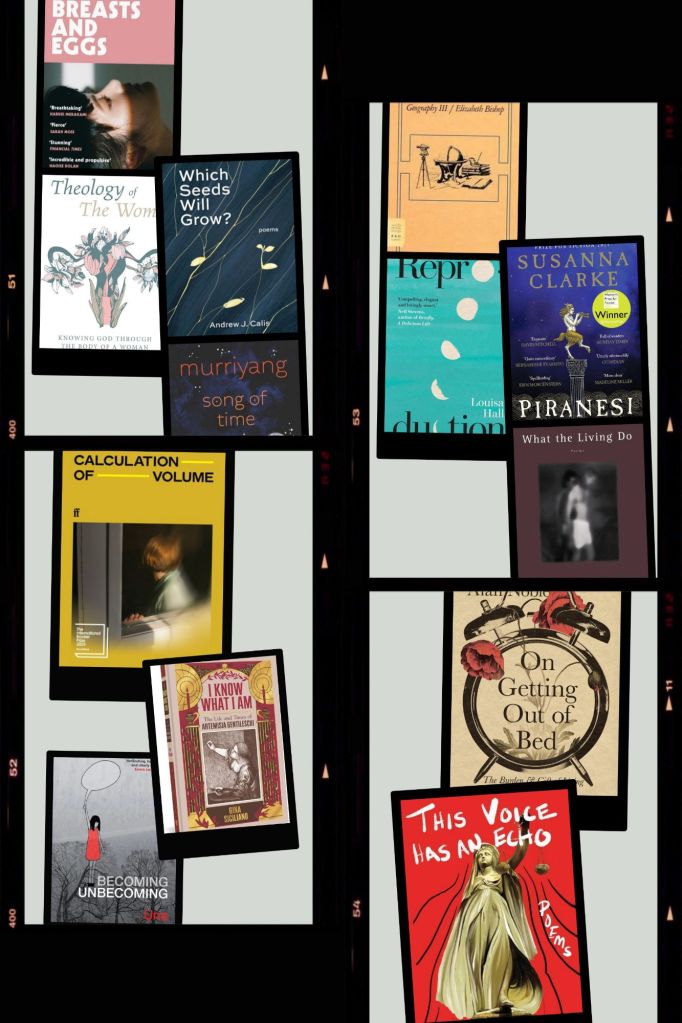
I consumed so much poetry this year that it’s hard to single out the highlights. Some I remember loving profoundly when I first read them but can’t tell you now why. But my journey through the complete Elizabeth Bishop at the start of the year has stayed with me, especially Geography III, which features many of her most famous poems and is Bishop at her most formally complex and dextrous. Her friend and mentor Marianne Moore also brought me almost to tears with the beauty of some of her lines in What Are Years? In new poetry, I discovered Palestinian-American poet Andrew Calis when he reviewed my latest book for Fare Forward. Reading Which Seeds Will Grow? felt like meeting a new friend: tender and grounded in the grace of everyday things while also soaring, cosmic and sublime. I will return often to his work, and am grateful to have had it enter my life. Likewise, but in a very different vein, was Emma McCoy’s This Voice Has An Echo, a marvellous collection of Midrash-like poems on Old Testament prophets. McCoy is a Christian poet who isn’t afraid to make her prophets swear and does not varnish over the messiness of life but manages to develop a voice that echoes with grace and hope. I was late to the party with Marie Howe, but her Pulitzer-winning collection this year made me go back and discover her older work. What the Living Do, which primarily concerns her brother’s death with AIDS but also wrestles with gender and the world that women grow up into, is raw, visceral and transcendent. I had a similar feeling reading Michael Kleber-Diggs’ Worldly Things, a tender and vulnerable portrayal of fatherhood and of growing up black in America.

In fiction, I struggled to keep up with a lot of the major literary prizes this year like I normally would, but it was a great year for the International Booker. The winner, Heart Lamp by Banu Mushtaq, is well worth the read, though I must admit I found it difficult: the distinctiveness of its cultural voice, reflecting a side to Indian culture not often read about (Muslim women of Southern India, written originally in Kannada, with some Urdu and Arabic), also made it very unfamiliar and sometimes alienating to me. But I enjoyed seeing a collection of short stories win a major award and the collection gives voice to women’s perspectives in a context where they might not often be heard. Other nominees stood out to me more. I reviewed Vincenzo Latronico’s Perfection for Fare Forward, so you can read my thoughts on it in more detail here, and my review of the first three parts to Solvej Balle’s On the Calculation of Volume when it comes out in Fare Forward’s newsletter in the new year. I also discovered some contemporary classics that I’ve missed previously. Alias Grace showed me that my unexpected love of The Handmaid’s Tale was not an anomaly; I think I actually like Margaret Atwood. She is sometimes austere, always challenging, but surprisingly tender and humane. And Susanna Clarke’s Piranesi, which I initially thought might be overhyped, was every bit as complex and beautiful as I’d been told it is. I also found myself delving into lots of books about women’s struggles with fertility and other aspects of being in their bodies: Mieko Kawakami’s Breasts and Eggs was a rich and engrossing story of two sisters, one planning a breast enhancement operation, the other exploring the complex and often unregulated world of sperm donation. Louisa Hall’s Reproduction was a much darker work, blending accounts of Mary Shelley’s life and work with the vivid, often confronting story of the narrator’s experiences of childbirth and miscarriage. It verges at times on body horror but in a way that remains grounded in the realities of life, and it shocks not to horrify or disgust but to help us understand and connect. I was also entranced by Ali Smith’s unnervingly realistic dystopia Gliff and its subtle and quietly chilling exploration of the boundaries between survival and compliance. In short fiction, I was spellbound by Pippa Goldschmidt’s Schrodinger’s Wife, a collection of stories of forgotten and marginalised women in science which opened my world to women who should be much more famous than they are, including Lise Meitner who is now a key player in the new collection of poems I’m working on.

There were not many non-fiction standouts in my reading this year, but Christy Angelle Bauman’s Theology of the Womb was an incredible read. It begins with the question: if women are made in the image of God as much as men are, then what can we learn about God from the experiences that women have in their bodies? From there it becomes one of the most comprehensive theological reflections on female embodiment that I’ve encountered, going even further than A Brief Theology of Periods, which I was already amazed by (and included in this list in 2022). It’s a rare theology book that can deal with as much pastoral nuance and spiritual depth with menstruation, lactation, clitoral orgasms and mastectomies, and it is heart-wrenchingly personal as well as profound. Very different in subject but equally profound, seasoned journalist and theologian, Wiradjuri man Stan Grant’s Murriyang is his most personal and theological work yet: a memoir of his dad, a biblical lament poem for the darkness of Australia’s history, as well as a meditation on God, memory and time, exploring Christian spirituality in a way that does not shy away from any of the traumas of the past but embraces God with an unashamedly Wiradjuri consciousness. Alan Noble’s On Getting Out of Bed is also a wondrously honest and surprisingly hopeful book. Essentially asking the same question that Camus began The Myth of Sisyphus with – why should you go in living when you feel crushing depression and despair at life? – he arrives at a uniquely Christian answer that offers no trite platitudes but ultimately affirms the value of living despite everything.

In graphic novels, there were not as many highlights as in previous years. I adored Gina Siciliano’s biography of Renaissance artist Artemisia Gentileschi, I Know What I Am, a confronting but inspiring story of an extraordinary and resilient woman, filled with Siciliano’s evocative renderings of Gentileschi’s art. Una’s Becoming Unbecoming, a gritty examination of the author’s own experiences of gender-based violence against the chilling backdrop of the Yorkshire Ripper murders, was unflinching yet sensitive in how it presented its challenging and highly important subject. The Emotional Load, French cartoonist Emma’s follow-up to The Mental Load, was not as life-changing for me as her first (see last year’s reading recap for that one), but it was still powerful in its simple but evocative illustrations and matter-of-fact storytelling.

Two honourable mentions need to be given to 2025 releases of new books by literary veterans. Anne Tyler’s latest novel, Three Days in June, isn’t the late career masterpiece that Redhead by the Side of The Road and French Braid were, but it has all the hallmarks of Tyler’s Baltimore universe, and the same compassionate and unsentimental portrayals of its flawed characters, while developing a narrative voice that is at once distinctly Tyler while also feeling new. Besides, any new Tyler is worth reading because it might be her last. The same can be said of Luci Shaw, whose An Incremental Life sadly did turn out to be her last, with the legend of Christian poetry dying late this year at 95. It’s a wonderful final work in a glorious career, with touchingly raw and tender renderings of old age and the fullness of a life of love lived before God. And which poet doesn’t quite to be still writing like Shaw was at 95? See you in glory, LS. You made contemporary spiritual poetry seem possible and like something I wanted to create.

It turns out that reading books properly is far more fulfilling than pretending to read them. But I still have fifty books on my TBR list and another ten that I’m currently reading, so it’s time to get cracking on my reading for 2026.

What we call Dark – a poem by Matthew Pullar

What we call Darkis often what we don’t understand, or cannot yetexplain. Dark as in: unseeable; not observed.The inside of the box. Beyond the boundary.The energy stretching the universefaster than reason can catch. The matter that,unseen, drives gravity mad.But these too are dark: the consciousnessthat torments itself with unknowable things;the inside of the apple; the […]

What we call Dark – a poem by Matthew Pullar

Unmasking Acrostic

Readily it comes to me,
Easily, like a skin I slip into,
Judiciously chosen for comfort.
Even when unsought, it sits
Close by, ready to offer itself.
Take nothing for granted,
It whispers. Question all motives.
Overt or hidden, it never leaves,
Never leaves me be.

Some days, slow days, it seems
Easy-going as though, for that moment, it might
Not bother anyone. Trickster.
Sly thing. No sooner am I at ease than
It strikes, threatening an abyss,
Taunting with its silent, unfathomable prospects:
If x now, then surely y is next.
Vehement in its certainty,
Entertaining no doubt.

Do you see this happen on my face?
You may do, and wonder at my sinking.
Sulking, my family called it;
Perhaps they were right. It looks like that,
How the face contorts to display the heart’s trenches.
Otherwise unseen, the narrow fellow sneaking in the grass,
Reticulated, spreading
Its nets, its networks, through a whole body,
A system of knots nigh on impossible to untie.

Interview with SparkLit

It was a great pleasure to be interviewed by an old friend, and filmed by another, for the 2025 Australian Christian Book of the Year awards night. Congratulations to the nine other books that were shortlisted for the award, especially to Stephen Driscoll for his award-winning book on AI, Made In Our Image.

You can watch the video of my interview here. It was filmed and produced by my good friend Lachie Outhred of Threaded Films.

“This Teeming Mess of Glory” shortlisted for Australian Christian Book of the Year

This week I heard the thrilling news that my latest book, This Teeming Mess of Glory, has been shortlisted for Australian Christian Book of the Year for 2025. It has been selected alongside a diverse range of books and authors, including First Nations Christians and academic theologians. I’m honoured to be recognised for my contribution to Australian Christian literature and to be included alongside so many wonderful authors. The winners will be announced at the awards ceremony later in August. In the meantime, if you haven’t bought yourself a copy yet, you can purchase it directly from the publisher here.

Is it ADHD or the patriarchy?

Last year I found myself deep-diving into feminist theory. It began with reading “The Handmaid’s Tale” and then following it up with the first book by French comic book artist Emma, “The Mental Load”. After that I was hooked, and finding my world of male privilege reeling from it all. I’d read my fair share of feminist theory at Uni, but last year a mixture of life experience and the clarity of what I was reading meant that things my wife and other women around me had tried to get me to see for years began to make sense. Recognising in Emma’s comics so many statements that I had unthinkingly made myself, I started on a quest to recognise all the things I have been ignorant to in my life because my culture has allowed me and other men to be ignorant to them. Phrases like “weaponised incompetence” cut deep when I recognised myself in them, and Emma’s comic entitled “You Should’ve Asked” made me see how many times I had been guilty of waiting to be asked when the women around me simply saw what needed to be done and did it.

But there’s a complicating factor in all of this. You see, I also think I probably have ADHD. I have not yet been diagnosed, and it’s possible that I am able to function at such a level that I wouldn’t be diagnosed anyway. That remains to be seen. But I have begun to realise things about myself that have made life – especially adult life – difficult for me in ways that I have not previously been able to articulate: the ways I vague out over verbal instructions, how I move on from one task to the next without completing what I started, how easily I become distracted, how much I struggle to organise myself, how easily I lose track of time or where I put my glasses or my keys. And some of these struggles make things like domestic responsibilities and parenting extra challenging. What might at times look like I’m failing to take responsibility, or assuming that it isn’t my job to do as the man, is often actually me becoming distracted on a side-quest or being overwhelmed by a multi-step task and not knowing where to start.

But here’s the thing. I wouldn’t grow so easily overwhelmed with domestic responsibilities if I’d been trained all my life to do them. When I learnt as a teenager to do my own laundry or cook basic meals, I felt I deserved a medal, and was often treated like I did, because I was being “one of the good ones”. But I was never trained to manage all domestic operations, never taught about home-making or hospitality, certainly never taught that other people’s comfort was my responsibility. I learnt from a young age what jobs I simply never had to put my hand up for, learnt quickly what things I could simply assume a woman would do. No-one ever used those words with me; no-one had to. I could see it all readily by myself: the way all the women at family Christmas would go into the kitchen while all the men went into the loungeroom to read their new books. No-one ever taught me this was the way it should be; but neither did anyone ever teach me to hold my keys between my fingers when I was walking at night, nor did anyone teach me to be quiet in meetings so I wouldn’t be taken as bossy, or tell me that the way I dressed would control how others acted. I learnt what I could take for granted the same way I learnt to walk or breathe. It took nearly forty years for me to see that it could be, should be, any other way than this.

So yes, some domestic tasks may be extra hard for me because my brain tends not to brain very well when it feels overwhelmed, or because I was lost at the second step in the verbal instruction and distracted by the poem I started to think about writing while you were in the middle of your sentence. But they’d be a whole lot easier for me if society had begun teaching me from birth to do them the way it taught most girls my age how to do them. Instead, I learnt at a young age what jobs I could simply compartmentalise out of my mental load; and now I’m having a hard time, as a neurodivergent 40-year-old dad of three, to learn to do things differently.

But let me tell you what I’m planning to do most differently. I’m planning to teach my three boys to take responsibility for their home and their community. I’m planning to teach them about the power they will wield as men, and the responsibility they have to be different as men. I’m planning to teach them to notice a messy room and not to leave it for someone else to clean up. And I’m planning most of all to teach them to make space for others and to listen to people who aren’t like them. Because I only began to see what I was missing when I tuned in to others who experienced the world differently to me, and I wish I’d been able to have a forty-year headstart on all that I’m trying now to learn.

I want my boys to learn early what I am only now beginning to understand.

Christ is risen?

He is risen indeed,
and the children, certain of this
recurrent event, rise at first
opportunity of dawn,

to greet a table laid for the event,
the celebration of miniature chocolate tombs, left
hollow to declare, “He is not here! He has risen, just
like He said He would.” But we

sleep-weary grown-ups rub eyes, ask,
“Really?” in our pragmatic hearts, too busy
hoping for a day without squabbles, wishing
against all reality, that this year the chocolate

might not cause so early, so emphatic a slump
in resurrection joy. And I, willing my fingers to declare
the truth my heart questions, type to my family
group chat the words, “Christ is risen”, rehearsing

the annual entry into truth, even when it seems
distant from the daily reminders of bills, school
uniforms (holidays nearly finished) and schedules
that announce the day’s scarcity of resources.

“Christ is risen” my thumbs declare. But a child
bumps me and the willed exclamation mark becomes
a question. Has He risen? Will He rise again, this year
as in the years before?

Believe it, hands. Believe it, heart.
What was true two millennia’s midnight ago is true
at this year’s first break
of doubting dawn.

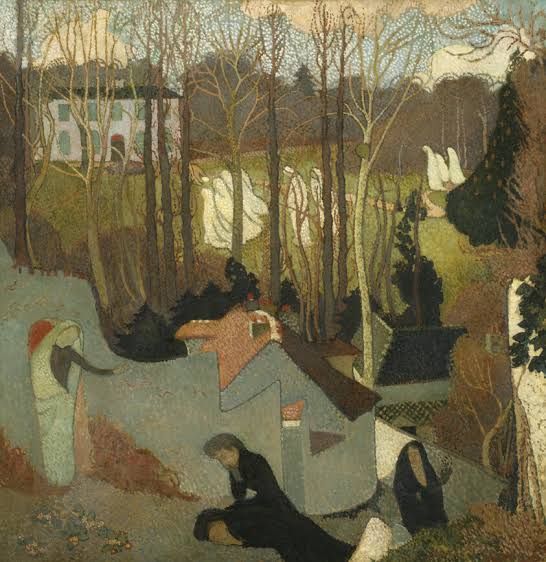
Maurice Dennis, “Easter Mystery”, 1891

“This Teeming Mess of Glory” now available

It’s officially here! I’m delighted to announce that my new book “This Teeming Mess of Glory” is now available for purchase online from Wipf and Stock, and coming to other online retailers soon.

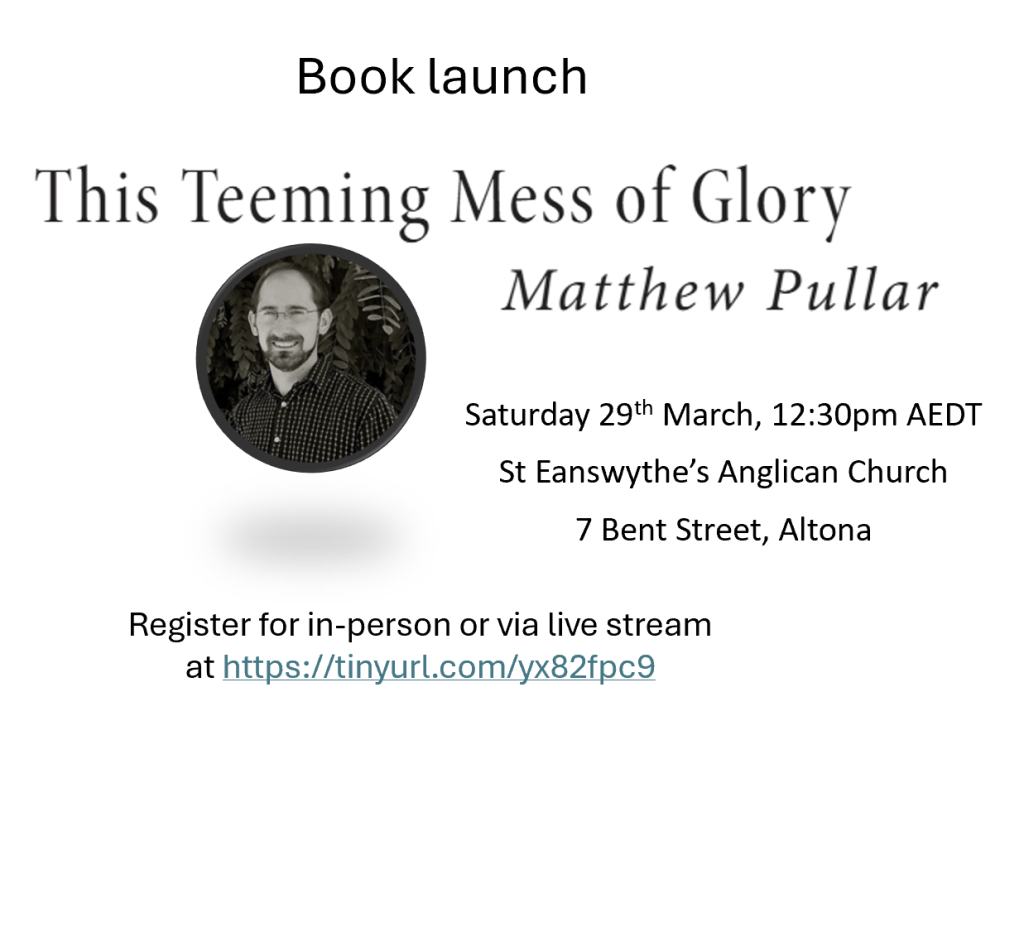
Also, don’t forget to register for the book launch on Saturday 29th March, 12:30pm Melbourne time. You can join in person if you’re in Melbourne or register for the live stream. If you can make it in person, you can also preorder signed copies via the Eventbrite link, at a $4 discount. I hope to see you there!

Book launch: This Teeming Mess of Glory

It’s getting close to the time for my new poetry collection to be released with Wipf & Stock’s Resources imprint. I’ll share the details here when the date arrives along with info on how to purchase it online through W&S or Amazon. In the meantime, I’m excited to announce that I’ll be having a book launch on Saturday 29th at 12:30pm Melbourne time. For readers in Melbourne who can come along in person, you can pre-purchase your copies of the book to collect at the event. For everyone outside Melbourne, the event will be live streamed. Just register online via the link below and I will email you with the details for the live stream closer to the time. I’m thrilled to have Whitney Rio-Ross, author of the wonderful Birthmarks and poetry editor at Fare Forward, joining online to help launch the book. I hope to see you there, whether online or in person, to help celebrate this book that is more than fifteen years in the making!

Click here for the Eventbrite registration page.