
Reconciling Wind Part 5
The Martyr’s Apology (For Justin, Martyr)
I, Justin, the son of Priscus and grandson of Bacchius, natives of Flavia Neapolis in Palestine, present this address and petition in behalf of those of all nations who are unjustly hated and wantonly abused, myself being one of them.
(Justin Martyr, The First Apology of Justin, trans. James Donaldson and Alexander Roberts)
Some faced what I cannot bear to know:
Crosses, beheadings, Colosseum games;
The sport of the powerful and scared,
They longed for a city for strangers such as they;
I hide where they led.
And Justin, the philosopher of Palestine, pled
With reasoning heads and unopened hearts.
Impassioned in his plea
For their reason to trump passion,
He reasoned till he bled;
And I, on the sidelines,
Hold their coats and avoid their eyes
While he holds us spellbound with his call to the truth,
Crying for mercy but strong when denied:
He knew whom he trusted;
So Justin’s eyes stare firmly where
Mine dart to the ground; he stares down the kings
Who are but false kings, knowing the Kingdom,
And knowing the Truth, which I, in my safety,
Only faintly know.
Vapour Poem
Reconciling Wind Part 4

Reconciling Wind Part 3
Reconciling Wind Part 2
Reconciling Wind Part 1
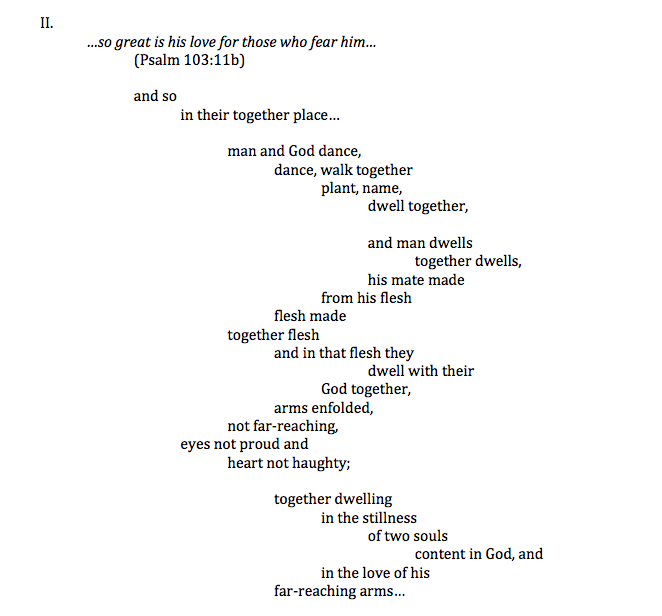
This week is the Australian Anglican Church’s week of prayer for reconciliation with Australia’s Indigenous people. It isn’t a topic I feel particularly well-equipped to address and am weary of showing up my own ignorance and, shamefully, frequent indifference on the subject. But I figure that that’s where much change happens – with ordinary broken people admitting that they are ordinary and broken but want, by the power and grace of God, to be otherwise. So here is the first in a series of poems that I will be posting, based on the creation stories of Genesis 1-3 and Psalm 103. I hope they are of some benefit.

Wind in the Valley (Pentecost Sunday)
In the valley of bones, I wait in the dryness,
The dryness of bones, the dryness of wind
Blowing on bones.
In my valley of bones, my bones sit and hear
The voice in the wind, a voice like the wind
Calling to my bones.
Speak to the bones; speak to my bones,
Wind of God. Be my breath;
Breathe in these bones.
Bring new flesh, new flesh on these bones.
Let them stand; let them rise,
New life in old bones.
In this valley, my bones rise and stand
To the voice in the wind, a voice like the breath
The breath on my bones.
Then are my bones covered in flesh;
Then is my flesh animated.
Then do I rise and soar in the wind;
Then will the Spirit pour through me,
Pour through my bones, give life to my bones,
Give life to old bones in this valley.
Pentecost, 597
Today’s poem recognises the work of Augustine of Canterbury and the monks sent by Pope Gregory in the 6th century to convert England. Augustine (not to be confused with his more famous African namesake) is perhaps most famous for converting King Ethelbert of Kent, a king significant both for having a marvellous name and also for later becoming a saint himself. Since the conversion took place on Pentecost, and today is the eve of Pentecost Sunday, I felt this was a fitting subject for a poem.
Pentecost, 597 (For Augustine of Canterbury) And after certain days coming into the island, [Ethelbert] chose a place to meet them under the open sky, possessed with an old persuasion, that all spells, if they should use any to deceive him, so it were not within doors, would be unassailable. They on the other side called to his presence, advancing for their standard a silver cross, and the painted image of our Saviour, came slowly forward, singing their solemn litanies… (John Milton, The History of England) With silver standard came Augustine’s Monks to Britain’s singing shores, Silver voices singing songs Of Christ the Sovereign, Saving King. Meeting them there on the beach, Ethelbert the King of Kent Heard them preach the Word because Their brave, long voyage had impressed him; And though he did not then believe He gave them leave to share with him And with his people that which they Believed to be the best to share; So under open sky they shared With Ethelbert, his heart prepared To stand against the spells they’d cast, And hearing them, he thought it fair, But still too strange, too new to take yet To his heart. Their spell, it seemed, Had that day failed. Yet he prevailed On them to stay and live in peace. And so they dwelt in Canterbury, The stronghold of the Kentish king, And there set up their sacred See, Their silver songs still ringing there, Although the king could not yet hear, His holds too strong; but when it came To Pentecost, the story goes, that He believed, the sovereign king, Upon his sinful, shaking knees. Undone. What silver words did they Speak, these monks of silver tongue? None that carried their own power. A solemn painting sternly shows A dove above the monks preaching, Their hands didactically raised and there Behind them Pentecost’s red clouds. No spell but this could fell the king: The fire that in Peter burned, Burning through the stronghold and Blazing saving-silver bright. The Consolations of Writing