The Ninevites believed God. A fast was proclaimed, and all of them, from the greatest to the least, put on sackcloth.
Jonah 3:5
Advent may not seem to be a time for sackcloth. For those who know the church calendar, it might seem more logical to think about repentance in Lent. But historically Advent and Lent used to be much more like each other than they are now, and it makes some sense that they would be. One of the images most associated with Advent is John the Baptist in the wilderness calling people to “prepare the way of the Lord”, and for John this meant repentance. We might think something similar as we imagine ourselves preparing to meet the baby King: approaching with a sense of unworthiness and contrition.
After the year we have had, we mostly want to skip the sackcloth and get straight to the celebration. Unlike Nineveh, we know the end to the story: God shows mercy and forgives. Why then do we need to go through with the sackcloth? Why not just rejoice? The truth is that rejoicing without repentance is entitlement. We focus on what we “deserve”, as though the world – even God – “owes us”. Certainly there’s a place for recognising that we need rest and need celebration, and God in His goodness gives us both. But He doesn’t owe us. Thinking that misses the point. Christians shouldn’t be surprised by grief and suffering in the world; we should know to expect it. What should surprise us is grace – not as though we keep forgetting the end of the story, but because it never fails to startle us with just how extraordinary it is.
Unless we know what it is to sit in sackcloth over sin, I don’t think we’ll grasp just how astonishing it is for God to lift us out of our ashes and invite us to meet His baby Son.
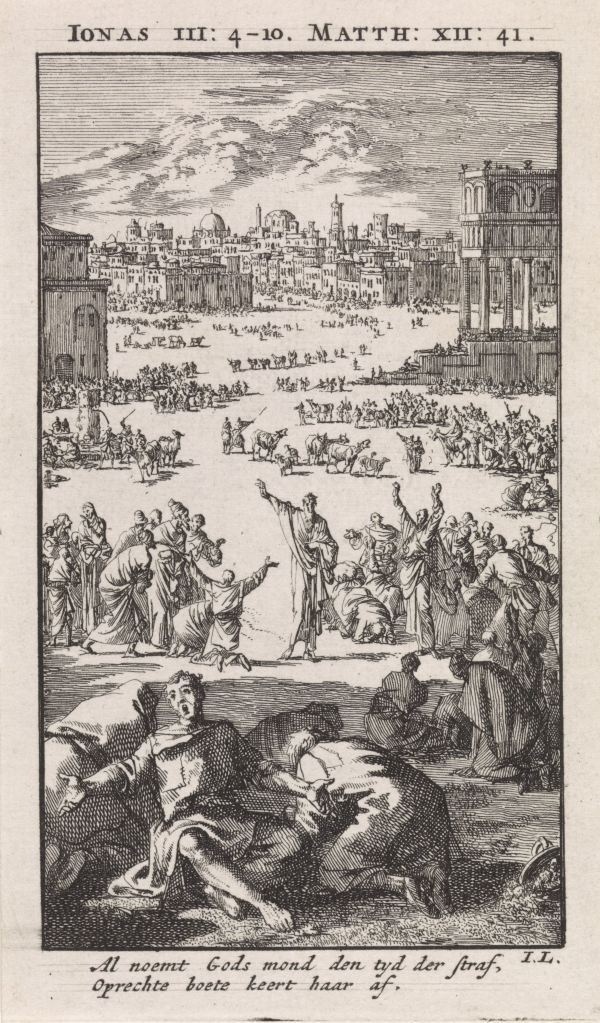
Jan Luyken, “Jona voorspelt de ondergang van Nineve” (1712)
Then the word of the Lord came to Jonah a second time: “Go to the great city of Nineveh and proclaim to it the message I give you.” Jonah obeyed the word of the Lord and went to Nineveh. Now Nineveh was a very large city; it took three days to go through it. Jonah began by going a day’s journey into the city, proclaiming, “Forty more days and Nineveh will be overthrown.”
Jonah 3:1-4
One of the greatest challenges of seasons like Advent and Lent is the way we must consciously withhold the pleasure and consolation of what follows: the joyful feasts of Christmas and Easter. Not that we forget how the story ends, that the centuries of waiting end with the Messiah’s birth, or that the three days in the tomb end with resurrection, rather we experience the spiritual fruit of these seasons of waiting and longing. These seasons also point us to present, ongoing realities in our lives that need to be brought into line with the bigger salvation story: yes, the Messiah has come into the world, but we also need to be reminded that He will come again; yes, Jesus has conquered death, but we also need to be reminded that our bodies will die before they are raised to new life. These realities are not made simple and easy to digest just because we know the end of the story; instead, we often understand them more by following the drama of the story through to its conclusion. Sitting with our own mortality teaches us to cherish the resurrection more. Sitting with Israel in its period of waiting teaches us to celebrate Christmas more fully and to learn to turn our longing eyes to Jesus’ return and not to the false hopes of this age.
So it is with stories like Jonah. The narrator moves so quickly over extended periods of waiting that we might miss them: Jonah waits three days and nights in the fish; Jonah travels through Nineveh for three days prophesying their doom; Nineveh is given 40 days warning of their impending destruction. And notice that Jonah does not even offer hope for Nineveh, simply warning: “Forty more days and Nineveh will be overthrown.” Yet the hope is implicit in the warning. Only a cruel God would give forty days for Nineveh to contemplate their doom without giving them any chance to repent. Besides, as we will see in the coming chapter, Jonah has always expected that the story will end not with destruction but with restoration, because that is the nature of God, to have mercy.
Yet there’s value in sitting with judgment for a little longer than is comfortable. If we don’t accept that we deserve the same fate as them, we won’t rejoice at the news that we’ve been spared. Moreover, we’ll be like Jonah, believing that we ourselves deserve mercy but others don’t; and what then? No hope of us being agents of God’s mercy in a world crying out for it.
One of the traditions that the church has had over the ages in the season of Advent is to contemplate the “last things” that face all people. It’s counter-cultural in an age – in a year – that wants Christmas to come early. But it’s a reminder that we need: we are mortal; we are not in control; we don’t “deserve better”; but God has given us what we don’t deserve because that’s the kind of God He is – righteous and just, but abundant in ridiculous grace.
Let me invite you to sit with the Ninevites for a moment today and remember the place you should be in, but for God stepping into our mess.
And here we arrive at the point that the children’s bibles are always leading: Jonah leaving the fish for dry land and “making good” what he has “vowed”. Yet there’s something quite curious about this moment in the story that we miss when we know it too well: the juxtaposition of salvation and vomit. It sounds sacrilegious, but there it is in the Bible. Jonah declares that salvation comes from the Lord, and then God commands the fish to vomit him up. If anything, in this moment of scripture vomit is the way in which salvation occurs: God saves Jonah from death inside the fish by being vomited up.
The fact that we might be squeamish at the idea, that discussions of vomit do not fit neatly inside our theology, says two things. First, it shows that we are uncomfortable with our own bodies, a fact that points both to the vomit-free glory that we instinctively feel we deserve. If our bodies as they are, inclined towards all kinds of abject and unpleasant fluids and the like, are all that humanity has ever or will ever know, then our discomfort seems odd. I have Philip Yancey and C.S. Lewis to thank for pointing this out to me. But secondly it also shows that we really don’t understand just how physical and visceral God’s saving work for us is. God gets down in the mud to make Adam. God breaths into Adam’s nostrils. God walks in the garden to find Adam naked and ashamed. God enters a womb and spends nine months drinking amnioitic fluid and kicking against his mother’s stomach before entering the world kicking, screaming, covered in blood and vernix. God spends thirty-three years as a man, experiencing all the glories and indignities that this entails, including the particularly awkward teenage years. And then God is nailed onto a cross, with scars that He still bears into eternity, has to heave Himself up and down, up and down, for hours in the body’s desperate bid to keep breathing, and then, as He dies, a soldier stabs Him in the side and blood and water flow from Him out onto the ground. The story of scripture is physical, earthy and messy. So yes, vomit and salvation go together, because God is not afraid of our mess.
But there’s another curious thing about this verse and a half that relates again to this word “vomit”. The Hebrew word qow is used only a handful of times in the Old Testament, unsurprisingly. Most of the times that it is used, it’s metaphorical: a figure of speech to describe land rejecting people from its midst. These three uses from Leviticus will show you what I mean:
Even the land was defiled; so I punished it for its sin, and the land vomited out its inhabitants. (Lev 18:25)
And if you defile the land, it will vomit you out as it vomited out the nations that were before you. (Lev 18:28)
Keep all my decrees and laws and follow them, so that the land where I am bringing you to live may not vomit you out. (Lev 20:22)
In these three verses we see a story of God rejecting the people who lived in the land before Israel because of their sins, and the warning that He will do the same if they fail to follow His commands. And the image that God uses here is of the land vomiting out the people.
Well, here Jonah – a prophet of Israel – is vomited out, not as rejection, but as salvation. Jonah disobeyed God, but he has returned to Him and so the fish vomits Jonah out onto land – but significantly, not onto Israel’s land, but onto land near Nineveh, the capital city of his worst enemies. Salvation belongs to the Lord, and He chooses whom to save and how.
Yet this fact is as uncomfortable for us as reading about vomit: we do not want to confront what it means for salvation to be entirely on God’s terms, not ours. And Jonah, sad to say, still doesn’t get it, as he washes the fish vomit from his clothes and sets foot once more on dry land, determined now to do the right thing.
“When my life was ebbing away, I remembered you, Lord, and my prayer rose to you, to your holy temple.
Jonah 2:7
It’s extraordinary how long we can try to live disconnected from the source of life. One of the things I value about Jesuit spirituality is the way it leads us to identify the sources of consolation and desolation in our lives, to pay attention to the things that bring us peace with God and those things that create unease in us. I for one can ignore the unease for some time, keeping busy, blocking out silence with distracting noise. All of this time I can feel that I am living, but it’s like I am functioning on an ever-depleting oxygen supply: soon, it will run out, and what then? Perhaps then I will blow up in anger, like I’m grasping at life on my own terms, or I collapse on the ground, unable to do any more, like Elijah in the wilderness. And sometimes I can revive briefly; some source of encouragement comes along with just though fuel to help me stand up again. But so long as I am ignoring the source of life Himself, it will only ever be short-lived, incomplete.
Many of us, like Jonah, can remember God when our lives are “ebbing away”. But can we remember Him when our lives are running along nicely? Can we remember Him when we are sailing in the opposite direction, when we know we are wrong but are too proud to admit it?
Teach us, Lord, to be uneasy with everything that is not real life, so that we will learn to long for Your life alone – even when it means surrendering life lived on our terms.
From inside the fish Jonah prayed to the Lord his God. He said:
“In my distress I called to the Lord, and he answered me. From deep in the realm of the dead I called for help, and you listened to my cry.
You hurled me into the depths, into the very heart of the seas, and the currents swirled about me; all your waves and breakers swept over me. I said, ‘I have been banished from your sight; yet I will look again toward your holy temple.’
Jonah 2:1-4
Jonah’s prayer inside the fish is one of the most overlooked parts of this book. Often it seems like nothing more than a poetic interlude and we want to keep moving to the next part of the story, to the drama of Jonah being vomited onto dry ground. But I am a poet so I love poetic interludes, and I’m also curious about much that features in this prayer. First, it’s essentially a collage of other biblical prayers, full of references to the Psalms which Jonah draws on to have words for this otherwise unprecedented experience. But it’s also curious in the story it tells: a story in which God seemingly answers Jonah’s distress by sending him into the deep and making a giant fish swallow him. Neither of these circumstances are how I would typically want God to deliver me from a storm at sea. Yet God is delivering him from more than the storm; He’s delivering him from all the things that have made him run from God. To do this work in Jonah, God isn’t simply going to spare Jonah any trial. Instead, He is going to send Jonah right into darkness in order to teach him about God’s light.
I’ve often been frustrated by how Southern hemisphere summers detract from Advent’s symbolism of longing for the coming of the light. When it’s daylight until 9pm, I rarely find myself longing for light. Here again I need Jonah to remind me: sometimes the best way to encounter God’s light is to open up the dark spaces inside ourselves. Jonah’s dark spaces were his tribalist hatred of neighbour and his transactional view of God’s mercy. Mine are a sense of resentment when God’s mercy does not accord me the comforts and affirmation I think that I need. In an Australian summer, on the brink of Christmas, it can be all too easy to ignore those dark emotions until they get the better of us. Yet God often calls us to enter them with Him – and this is expressed in no better way than the life of Jesus: entering the darkness of the womb for nine months, the darkness of imperial infanticide at the time of his birth, the darkness of poverty and oppression, the darkness of persecution, the darkness of the cross, the darkness of the tomb.
Jesus told those asking for a sign that He would only give them the sign of Jonah. Like Jonah, He entered deepest darkness for three days. Yet He was not overwhelmed by the darkness; even there He is strong, stronger than death. And so we, like Jonah, can encounter Him in the dark. Like Jonah, we might even be taken into the dark to save us from our own hidden darkness. We shouldn’t be surprised if that happens; it was the very thing that Jesus came to earth to do.
Now the Lord provided a huge fish to swallow Jonah, and Jonah was in the belly of the fish three days and three nights.
From inside the fish Jonah prayed to the Lord his God.
Jonah 1:17-2:1
There’s a line from Shakespeare’s Macbeth that has particularly held on to me since I first read it 20 years ago. It comes at the point when Macbeth decides that the only way to allay his tortured conscience is to simply accept that he must continue as he has started:
I am in blood / Stepped in so far that, should I wade no more, / Returning were as tedious as go o’er.
It might seem an odd quote to mention here, and a disturbing one at that. But I’ve always seen Macbeth as a play much more about mental illness than about murder, and there are many resonances with what Macbeth says here and, say, anxiety or anger. There’s physically a point when we are consumed by either emotion so quickly and decisively that it would be far harder to calm down than to simply let the feeling run its course. And indeed this is how our bodies sometimes respond; if we fail to breathe properly for long enough while in panic, our bodies eventually shut down so that we have time to reset. Or sometimes when we are angry it takes something dramatic, like punching a wall or having someone react strongly back at us, to make us “snap out of it”.
As with anxiety and anger, so with ignoring God. We begin on a path of huffish indifference, and then it continues until, even in the midst of a storm, we don’t think to pray. And it takes something monumental to get our attention, to break through our indolence and pride.
So it is with Jonah. Again, the scene that awaits us is so familiar that we tend to rush towards it. The children’s Bibles that I read my sons often do: Jonah is in the fish, they seem to say; let’s quickly make him pray and then get out of the fish and do the right thing at last. But that’s not how it goes, at least not how it feels for Jonah, who like Jesus must remain in the tomb for three days before returning to the land of the living. And who knows at which point in the three days Jonah starts to pray; but this, significantly, is the first time in the whole book that Jonah talks to God. The book begins with God talking to Jonah, but at no point in the first chapter does Jonah himself talk to God. Only when God has sent a life-threatening storm and then a giant fish to swallow him does Jonah pray.
It shouldn’t have taken a storm. It shouldn’t have required Jonah to be thrown into the water. It definitely should not have warranted much time at all inside the fish’s belly. But Jonah, like me, takes a long time to shake out of his rage against God and turn towards God instead. Why? Because he, like me, would much rather call the shots than be called to join in what God is doing.
This is why we need Advent, and why I am taking such a circuitous route to get there. Because what God has done in Jesus is so counterintuitive, so contrary to what we would demand of God in our pride, that, if we are to have any chance of seeing God’s work for what it is and participating in it as we should, we’re going to need to learn to listen to God in the midst of our rage. Praise God that He sends storms and whales. Praise God that He has come himself into this rage of being flesh.
God of sea and dry land,
God of Nineveh, Bethlehem
and the belly of the whale,
God of heights, God of depths,
God of my darkest abyss:

I have made
myself my god.
I must
become
Nothing.
You
must
become
All.

I have blocked the channels where
You reach me in my darkest hour.
I have clenched my fist to fight
in place of Your hand charged with  life.
I must go I-don't-know-where
to find that You are everywhere.
I must enter deepest night
to find that You alone are Light.
J.M.W. Turner, “Snow Storm – Steam-boat off a Harbour’s Mouth”
The sea was getting rougher and rougher. So they asked him, “What should we do to you to make the sea calm down for us?”
“Pick me up and throw me into the sea,” he replied, “and it will become calm. I know that it is my fault that this great storm has come upon you.”
Instead, the men did their best to row back to land. But they could not, for the sea grew even wilder than before. Then they cried out to the Lord, “Please, Lord, do not let us die for taking this man’s life. Do not hold us accountable for killing an innocent man, for you, Lord, have done as you pleased.” Then they took Jonah and threw him overboard, and the raging sea grew calm. At this the men greatly feared the Lord, and they offered a sacrifice to the Lord and made vows to him.
(Jonah 1:11-16)
I wonder what Jonah expected at the moment of being thrown into the raging waters. He seems at this moment to recognise his responsibility, to know that he is the cause of the storm, so perhaps he expects that, when he is thrown overboard, the storm will end. But what does he expect will happen for him personally? He certainly could not expect what comes next – the part to the story that is so well known that I want to delay it a moment longer before looking at it. He could never have seen that coming, and so I want to pause at this point of uncertainty. I want to freeze on Jonah at the very point when he plunges into the sea: what does he expect at that moment?
He knows, as we saw in yesterday’s passage, that his God is the “God who made the sea and the dry land”. And so no doubt he expects that God has control over the sea as He does over all things. But what does he think will happen when he is thrown at the mercy of this all-powerful God, after having defied and run away from Him? Is Jonah’s only thought one of freeing others from the storm, or does he consider what might happen when he hits the waters and goes under?
Perhaps he doesn’t think that far ahead. One of the effects of anger is that we become unable to think outside the constraints of the thing that has made us angry. The kind of intensified emotion that our brain experiences in times of anger actually shuts off the brain’s ability to contextualise, and so we often find ourselves stuck in a catastrophic present moment, unable to think of elements to the past, the present or the future that might alter or at least ameliorate our responses. Jonah, I suspect, does not think of very much at this moment apart from seeking an end to the storm. He makes it as far as recognising that he needs to face up to God, but there’s no sense that he expects mercy or restoration from God, simply justice: a black and white model of retribution, no doubt the same model that has led him to think that the Assyrians do not deserve forgiveness in the first place.
And so Jonah plummets into the waters, and in a moment the sea is calm. What then? Does he take a breath, relax, and wonder if all might be well? Or does he find himself plunging deeper, moving further out of control even as the waters above the surface become still? Sometimes this is all we can do, to plunge into the abyss, in the hope that we will find God there. Yet this is the very thing that we needed to do in the first place, that we were unwilling to do: to plunge into the chaos of our thinking and instability, with God there to navigate it for us. Instead, we chose anger, resentment, running away. The abyss never left us, even when we tried to silence it or disguise it with rage. Now we have to face it; plunging head-first, we enter the abyss, and find that God has always been there, waiting for us.
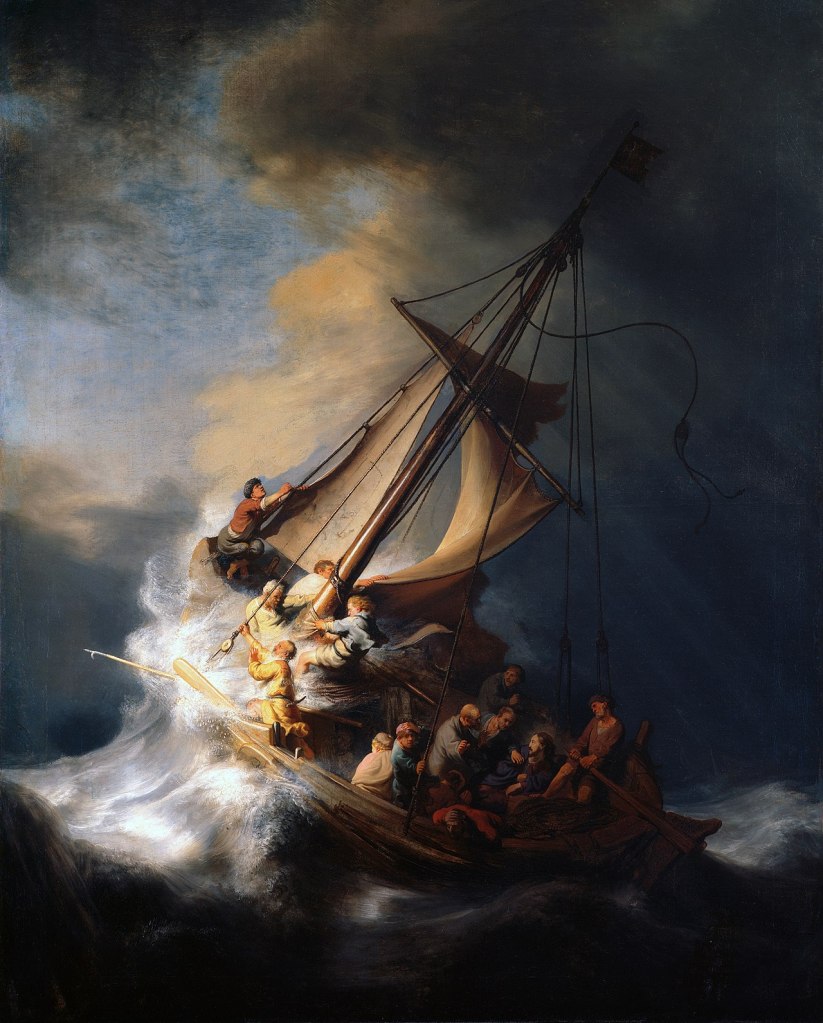
Rembrandt van Rijn, “Christ in the Storm on the Lake of Galilee”
Then the sailors said to each other, “Come, let us cast lots to find out who is responsible for this calamity.” They cast lots and the lot fell on Jonah. So they asked him, “Tell us, who is responsible for making all this trouble for us? What kind of work do you do? Where do you come from? What is your country? From what people are you?”
He answered, “I am a Hebrew and I worship the Lord, the God of heaven, who made the sea and the dry land.”
This terrified them and they asked, “What have you done?” (They knew he was running away from the Lord, because he had already told them so.)
The sea was getting rougher and rougher. So they asked him, “What should we do to you to make the sea calm down for us?”
“Pick me up and throw me into the sea,” he replied, “and it will become calm. I know that it is my fault that this great storm has come upon you.”
(Jonah 1:7-12)
The first thing that Jonah admits to is that he is defined by relationship with God – and not just with the god of his people but with the “God who made the sea and the dry land”. Most ancient religions had different gods for the sea and the land. The sea was associated with a chaos that needed to be subdued in order for dry land and human life to exist. Other gods managed the harvest, the storm, war, peace. Jonah’s God is a God of unity, and of everything. He cannot pick and choose which bits of his life he allows God to rule. And he cannot defy God and expect the world to be unaffected.
As anger turns us inward, it can create the illusion that we are worlds unto ourselves. We can try to ignore the impact that our anger has on others, and we can also ignore our responsibilities to others that continue even while we are raging internally. Jonah, a prophet, is called to be God’s messenger. He has refused one opportunity to be that messenger for Nineveh, and here, on the boat, he is failing to be that messenger to the others on the boat. In a book filled with irony, another irony appears here: that the others on the boat show greater reverence for Jonah’s God than he does. Compare this with Paul, who used violent storms at sea as opportunities to share God’s message with his companions on the boat. Compare this even with the fearful disciples who knew that shaking Jesus awake could rescue them from the storm. Jonah’s response is much more the one I must admit that I am inclined towards: an inward-focused denial of my responsibility to others as a person of God.
The turning point for Jonah is to accept responsibility – to recognise that his disobedience to God has not just been a matter between him and God but between him and others, even him and creation. The earth is impacted by our sin, and so are our relationships. And when we rage against God, we make ourselves gods of our own little, internal kingdoms, failing to see the storms that we have made around us and the lives that are threatened by our failure to pay attention.
The answer? Stop ignoring the storm. Enter the storm. Because the God of sea and dry land will be there in the storm, waiting for you to speak to Him.
Then the Lord sent a great wind on the sea, and such a violent storm arose that the ship threatened to break up. All the sailors were afraid and each cried out to his own god. And they threw the cargo into the sea to lighten the ship.
But Jonah had gone below deck, where he lay down and fell into a deep sleep. The captain went to him and said, “How can you sleep? Get up and call on your god! Maybe he will take notice of us so that we will not perish.”
(Jonah 1:4-6)
Why is Jonah asleep? Often I’ve heard Biblical stories like this interpreted to demonstrate complacency or obliviousness: Jonah is asleep because he is not paying attention, spiritually dull. Perhaps this is the case. But, when I think of myself, I often go to sleep – physically or metaphorically – when I don’t want to talk to God. And often this is because I am angry, and I know that to talk to God I will need to let go of at least some of my anger. I can’t maintain all of my rage and also do the self-humbling that is necessary to pray. I know God well enough to not let loose with all my fury, but I’m not ready to unclench my fists enough to fold my hands in prayer.
It’s a guess, but an educated one, to suggest that this might be where Jonah is at here in the story. Certainly it fits with the Jonah we see later, angry enough to die because God has relented and not destroyed Nineveh like he hoped. Jonah knows, I’m sure, that he should have followed God’s command; he knows he shouldn’t be on this boat; he knows he is in the wrong. But he doesn’t want to think about it, because thinking about it would require humbling himself, and he’s not ready to do that. So he sleeps.
It strikes me how often I clench my fists in stress, as though I am ready to start punching at the first moment that it’s required of me. We cannot talk to God when we are like this, not properly. To talk to God, we need to stretch our fingers out, let go of our pent-up rage, and let Him be God while we are children before Him. Sometimes we even need to physically open our hands up before Him as an expression that we are ready to receive from Him whatever He has. But even this is humbling. Attention to God is humbling when all we want to do is listen to our own pre-recorded loops of internal rage.
Like Jonah, we need to be shaken awake and told, sometimes by the least expected of people, to stop hiding from God, huddled in our own fury, and to turn to Him instead – to turn in humility and wait.

 The Consolations of Writing