Family reunion brings us here,
where gum trees open onto two eternal flames
smoking up suburban Sunday sky.
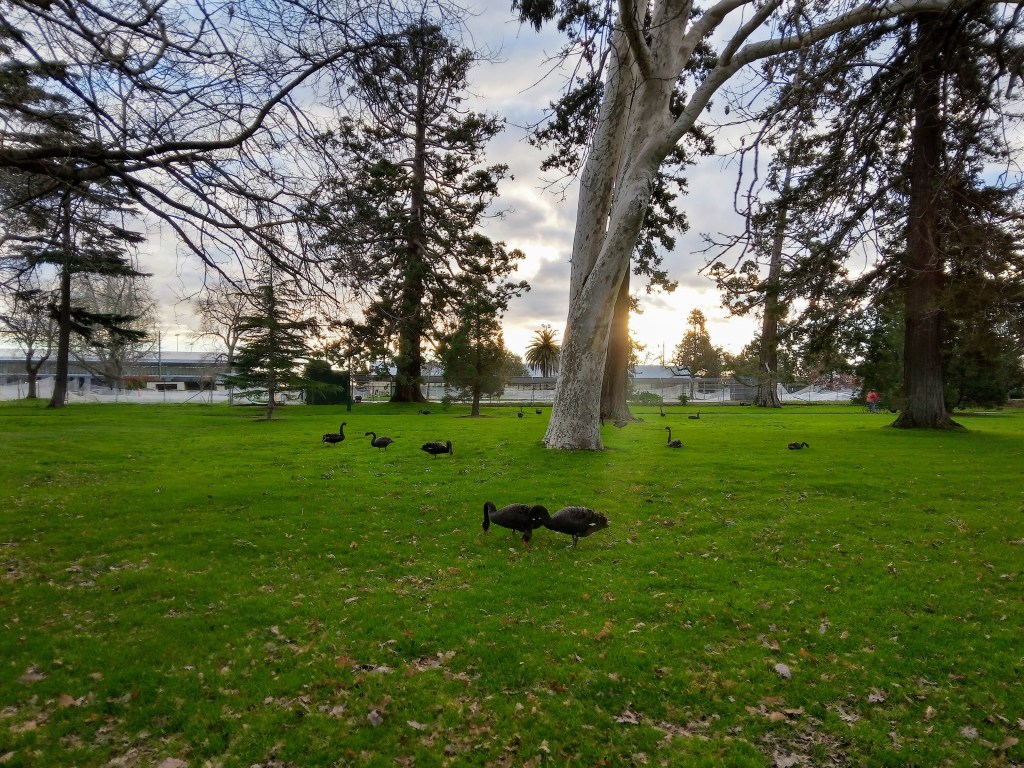
Our park - the edge of our travel limits, sits
beside quiet street and under
the refinery's steady shadow.
Two swings, two slides, ancient eucalypts,
and where houses fence the park's perimeter, a hidden gate
opens while we picnic and out
pops a man's head, then a man,
up for a chat or to survey the scene.
Here for 45 years, he tells us, he's seen
the refinery grow and housing prices fall,
smelt and breathed it all,
would never leave, not even for Queensland.

I doubt we will come here again,
yet the man in the fence shuts the gate,
returns to his 45-year-old-home for home can grow wherever
we stop, open our bags and rest.
Home has been here before; has been contested; will be
here again.
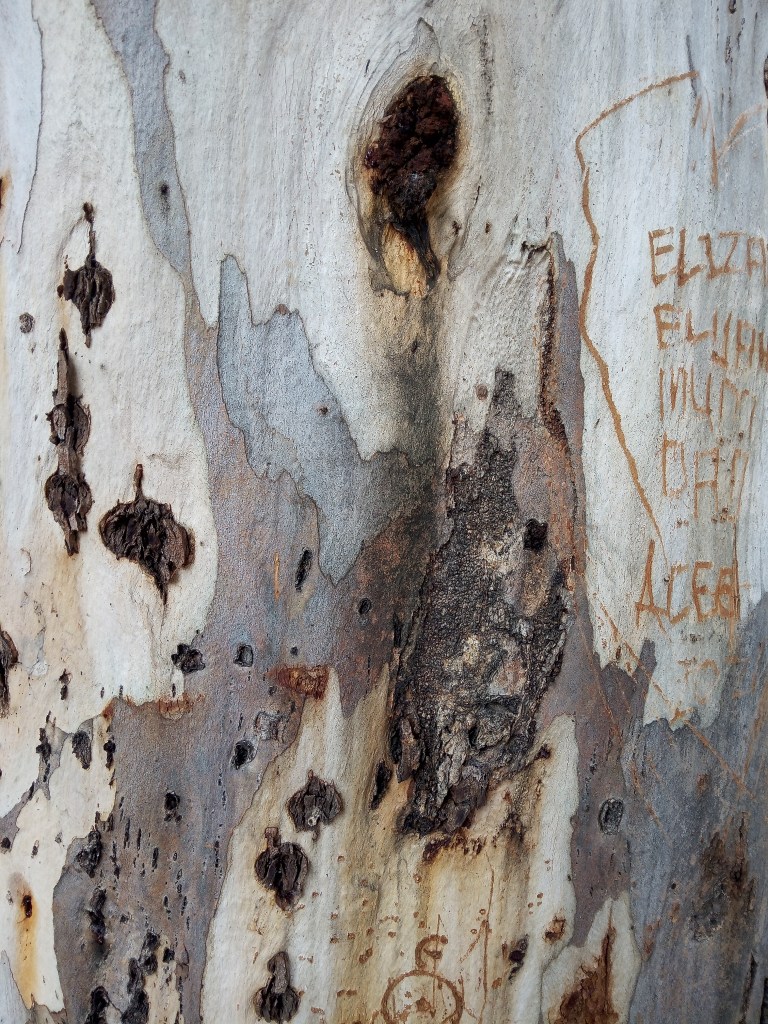
Eucalypt skin carries its scars,
carries its stories and its hopes.
Our stories, our homes, are refined in the scarring,
will one day erupt in air purer than this.
One day, our homes will open their hands
and fold you into their scars.
In early primary school I remember composing the beginnings of a poem in my head. It went:
I was born in Ballarat, some miles away from Melbourne, People always said to me, “Oh my, you must be well-born.”
While I chose to prioritise rhyme and rhythm over truth (no-one has ever called me “well-born”, it shows that, from an early age, place was important to me. Growing up in southern Queensland, I was determinedly Victorian. It was very important to me that I was born in Ballarat, even though I moved when I was one year old and have no memories of living there. I would never now say that I am from Ballarat. That hardly seems true. But where am I from? Ballarat for my first year of life, early childhood and primary school in the Gold Coast Hinterland, secondary school in West Gippsland, then various parts of Melbourne for most of the twenty years since I finished school. I have never had a single place to call home.
This means that I have often found comfort in the biblical texts that speak of God’s people as pilgrims, exiles, sojourners. Having no deep sense of belonging to one place on earth, I can easily focus on the belonging I will have in the new creation when what a good friend of mine describes as my semi-nomadic life will finally find a home.
But spending the last few days in the town of my birth with my family I have been reflecting on the ways that place shapes us and how we can likewise shape place. An older town, one of Victoria’s oldest, Ballarat feels much more European than my home of Werribee, for instance. There’s an abundance of deciduous trees, a huge artificial lake at the centre, English architecture everywhere, and while it’s all incredibly lovely, I can see how the landscape was changed dramatically by European settlers during the gold rush of the late 19th century. To make this new foreign place feel like home the Europeans changed it indelibly, and in doing so had a lasting impact on how the traditional custodians, the Wathaurong or Waddawurung, could engage with their country.
This week is NAIDOC week in Australia, a week for celebrating Australia’s first nations people. The theme for this year’s celebrations is “healing country”. As I have reflected on this theme, it has struck me how the Bible’s vision of the new heavens and new earth is one of renewal and restoration not of replacement. And that renewal works on so many levels, reconciling those in enmity with one another, healing broken relationships, ending hostility between land and people, between animals. It also involves a restoration of home. The new Jerusalem is, I suspect, less about a literal political state than it is about God dwelling once more on earth with His people, their home and His dwelling restored.
If we believe this earth will not be replaced but renewed, then as kingdom people we should be working for that renewal now, as a sign of the kingdom that is coming. And that means, among other things, healing broken relationships within the land and healing also our relationships to the land.
Place matters to God. Land matters to God. Relationships matter to God. I want to live my life in a way that works towards healing in all these things.