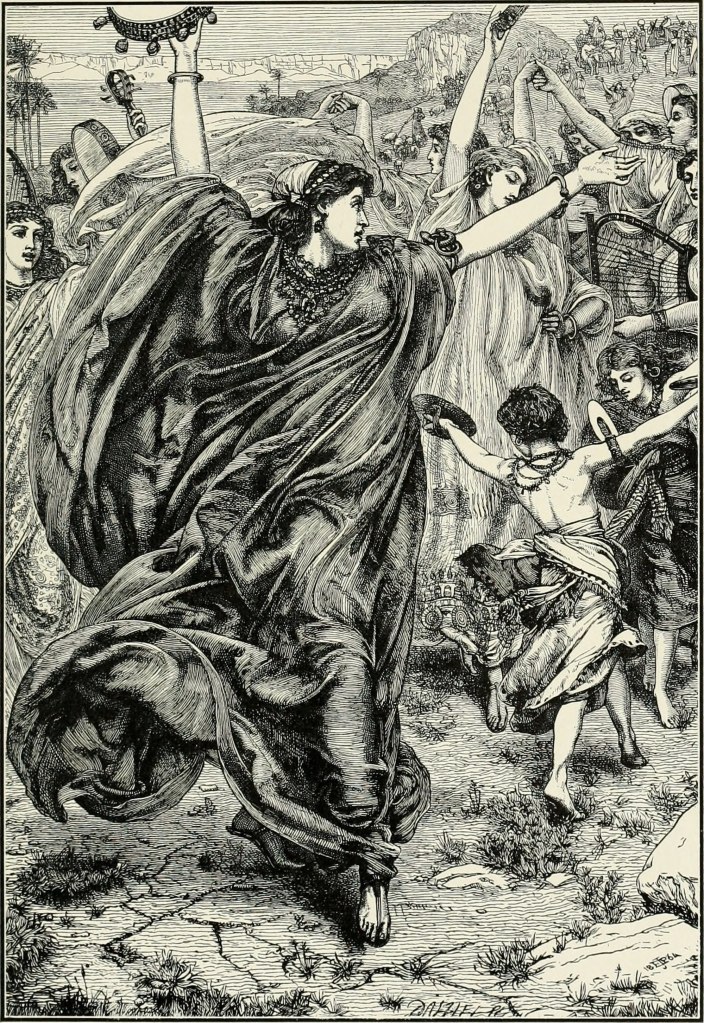
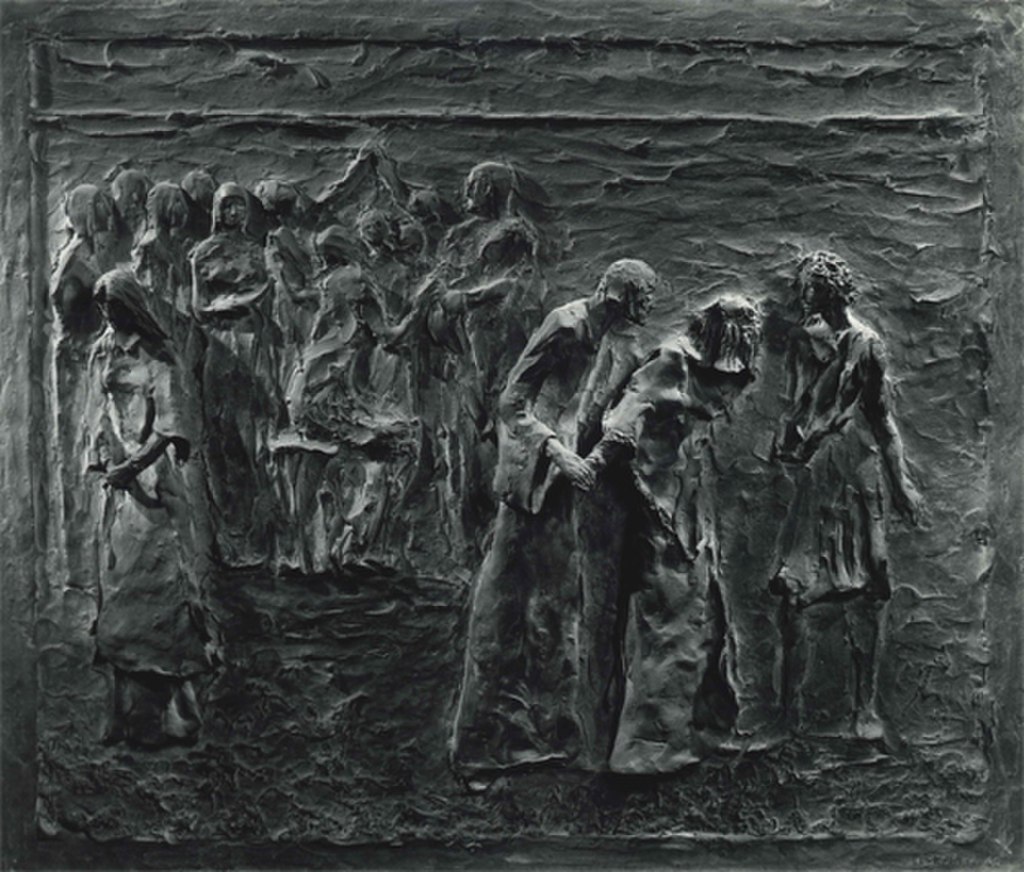
Days brighten as legs lag; Christmas’ pulse confuses with Advent slowness. How do we find stillness in this pounding purposeful ascent to year’s climax? Many rushed home for the census but few saw the signs, heard the angels, glimpsed the star. Slowness humbles. In weakness, in childlikeness, come. In seasonal fluster, in these high-pollen, heaty days, come. In competence, incompetence, preparedness and cluelessness, come. The season grows that readies as you wait.
Somehow, like
a miracle of new birth,
the children rise with
all the energy of Christmas morning.
I lag behind their delight,
lost still in the sleep I wish I was having,
yet lifted all the same to see
child hearts leaping
like an infant in the expectant womb.
The waiting will be what chafes.
Our spirits lag with Spirit's time.
Even by breakfast joy dwindles with toddler temper
and we all must learn in these waiting weeks
to turn our squabbling selves to your
slow Advent.
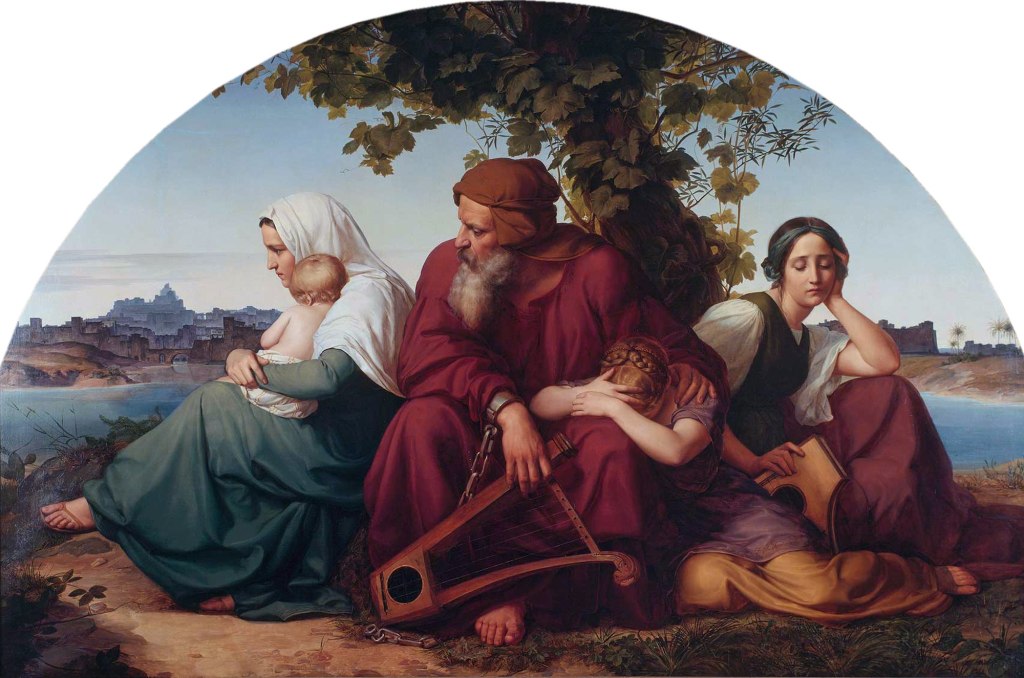
Eduard Bendemann, “Die trauernden Juden im Exil”, 1832, Wikimedia Commons
He took me
in his hand and said,
"You are my signet ring,
son of David."
And warm though
his ancient loving voice,
I gulped dust at the sound
of my ancient father's name,
swam in the expanse between
his day and mine, choked on
the bitterness of dead promise.

"You are my signet ring," he said,
"I will scorch you as wax and you
shall seal these words, shall sign
with my sign
that I shall do this."
O God, my bones cried
could it be? Still Jerusalem's
broken walls rent me. Still I
cried at memory of Babylon.
"I will," he said, in
a voice of silent thunder. "And you
are my seal. And this you will seal:

To the weak ones, the dead and dying,
the weeping, the starving, the retching ones,
the wretched, the righteous,
the strong, the strong-willed,
the hoping hopeless,
to Leah and Rachel,
to Tamar and Judah,
to Sarah and Hagar,
to Solomon and Sheba and Bathsheba.

I send you as a seal on this scroll,
to gospel, to console.
What is broken will be whole."
And he scorched me in the flames.
I was wax, I was waiting.
All the while he sealed me,
sealed the promise within me
and behold
the wax dripped like blood,
and behold it was good.
Print of Josiah’s messengers meeting with Huldah the Prophetess, Christoph Weigel, 1708, Wikimedia Commons
When the king, garments torn
with grief at the broken law,
sent messengers to me in hopes of hope,
I thought at first, Have you come to me, not
Jeremiah, looking for a mother instead
of a firebrand? It mattered little.
You cannot soothe a fire with lullabies,
can only shout loud and clear
that the whole town might hear.
For sometimes

the truth is worse than you fear.
"It's true," I told these
envoys to tell the young king,
who was yesterday only a boy seated
on an already broken throne.
"Covenant is as torn as your clothes
and everyone will feel the tear.
You can bury the law deep as the past
but cannot hide from it forever."

Their hearts were no doubt heavy
as they took comfortless
words back to a king eager
to turn hearts back all the same.
He would stand
before the whole people and call
back to Sinai, back to the soul's sorry desert,
yet one king more and it would all
be ashes before fallen walls.
Nonetheless his heart burnt.
Nonetheless he called.

And though history, with its way
of splitting truth in half to find it false,
should call me a weasel in the king's
law-making scheme, hear me on this:
I never twisted the truth to fit the crown.
I promised life
only as far as his heart, rent
beneath his ripped robes. No more.
No law, discovered or made,
could make a divided heart one.
No king could rule his own
heart, even less the nation's.
Only one,
a child far far far from Josiah,
only the king with no throne
could make these twisted hearts
wholly His own.
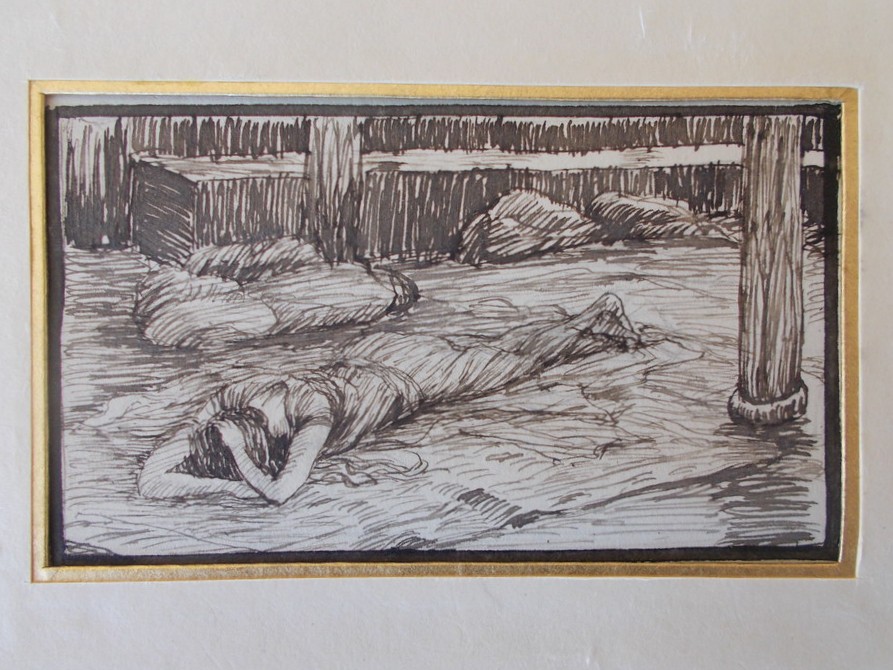
“Bathsheba Mourns her Husband” by James Tissot (Flickr)
Viewed from the voyeur's vantage,
she is only ever Other,
breasts bared or barely draped in dampness,
bathing or emerging from waters,
eyes come-hithering,
sometimes her whole body issuing its
dubious invitation.
No doubt David saw her this way,
eyes surveying the rooftops for all he called his own,
the private and holy ritual she performed
the only thin excuse his lust required.

Only Tissot has her clothed,
prostrate, grieving
the expendable Uriah, the second
in a three-stranded cord of griefs:
her body first, then husband, then son.
Had she known how history would blame her,
conflate her name with "Seductress",
she'd have grieved longer,
lain on the floor until
her swelling belly, the violator king's
bursting offspring, allowed it no longer.
At least Tissot gives her this dignity, letting her grieve
without end, without her body made
a vessel of desire.

Nathan too, though he clothes her by
unclothing the king's lie:
Nathan the prophet to whom
David's the naked seducer,
his sins stinking to heaven,
the whole world having not
hyssop enough to wash it away.
"You," he says, stripping off the dank,
swamp-sodden disguise,
"You, king, are that man."
Only then
does the whole filthy garment of privilege,
of droit de seigneur, fall
in a bare crumple of repentance.

And grace, breaking its unfettered way in,
makes a record, writes it down:
"Bathsheba, who was Uriah's wife". There,
alongside Rahab, Tamar, the used and maligned.
Grace names and reclaims. Slowly
Bathsheba rises from grief...
Woodcut by Julius Schnorr von Carolsfeld, 1860, Wikimedia Commons
They seldom ask why the men were there.
As they slipped down the wall, I thought:
Just as it's always been,
the men sliding away to their homes,
the shame slipping off their well-oiled skin.
Nothing touched them.
They would take their promised land just like they always had;
mine would be the leftovers,
mine the scarlet thread left dangling mid-air.

Only, as the walls shook like a pounding heart and
amidst this trumpeting change of the guards I caught
my breath and whispered, We're done for,
I found
my legs still standing, my
blood still pounding, my family
still about me, though all
Jericho fell in a mighty gasp,

and weak
though a scarlet thread was in such a blast,
it held me, bound me, and in that impossible instant I saw,
while stone crumpled
to sand to rubble to dust,
I saw

multitudes here,
beyond my sight, my time,
spread like a desert, like sand,
running, crawling, limping, reaching
grabbing like I grabbed,
clutching like I clutched,
at this scarlet grace dangling
its chance at life.

Now I live among them,
have learnt their wild, sea-parting stories,
have seen their virtues, their shames,
learnt the way grace drops like rain,
washing away, never denying, shame.
The scarlet hangs still, where I first placed it.
Feeble and flimsy the way to life often is,
scarlet the blood of mercy
coursing through our feeble veins.
Image: Charles Francis Horne, 1908, Wikimedia Commons
Forty decades in the desert and we
were worn down, weary from our weakness,
despairing of doubt,
catching past only in fragments like
morning manna: a whiff of Egypt's garlic,
a vague floating thought of dangers
lurking like crocodiles in the Nile.

Some fragments heavied us with
the burdens of their memories: water bursting angrily from rock,
rebellions and plagues,
golden calves smelting in the sun.

Others lifted like leaven:
the scent of lamb, blood like boon upon lintel,
waters waving apart,
a triumph of tambourines.

Others still flickered in their
seeming impossibility, yet stuck
as the bedrock above which
all else was possible:
defiant midwives, babies saved,
and a young girl waiting silent in the bulrushes
for an infant brother to be saved and to save,
stubby fingers pointing as if to say,

Wait. You'll see. There's something even better,
someone coming beyond Jordan.
Forty years waiting. Yet we'll see.
I’ve found this next one in the Waiting series hard to write. So hard that I’m a week behind in my weekly poems. Some of the stories that I’m looking at are stories I know very well, yet I’m seeing in them the pains of characters often marginalised in how we tell them. The story of Leah, Jacob’s neglected wife, is one of these, and it’s a story I feel ill-equipped to tell. I’m not sure I have done it justice, but it’s a start. May it at least give us a new way to see the workings of God’s grace in the forgotten and neglected.
“Marriage of Jacob and Leah” by Sylvia Lefkovitz, Wikimedia Commons
Leah
The ways of grace are slow and subtle. My father’s is wily; my husband’s too. Serpentine, they wind their way through lives, seldom giving without an eye to the favour, seldom expecting different from anyone else. My eyes look straight; I’m told they are dull (or radiant perhaps – I never know for sure), but I knew what I saw when he first came to us. He saw what all men see: he saw Rachel.
My father saw different: he saw a prize, and saw the way to extract it. I was the way – or part of it. “Go,” he said, sending me to Jacob’s bed. “He’s too drunk to know the difference.” As though I would not know either, would forget the way he usually saw me, would mistake his raptures for a confession that it was me, not Rachel, it was me all along.
If you would call me dull, it is only in this: that after years of wily men and their ways, I hoped with each child that soon he would change. Though I saw how his eyes turned to Rachel, how even his footstep differed when he turned to her bed, not mine, I still felt hope shiver with each son I gave him, and in that shiver a dull dream that now, now after all he would see me. Fool. Only with Judah, my fourth, did I see a way that, though subtle, was not wily, though it had winded and twisted and bent with me. Only with Judah did I catch something better. Now, I whispered. Now I will praise the Lord.
I was not born to choose.
From the very start they told me,
"Go here, do this, take that."
So it was no big step (I told myself)
when my mistress said,
"Go to your master's bed.
Give him a son. I can't."

I was not taught to say, "I won't",
never heard the word violate,
nor how a body was not
like a room that a master owned.
No-one told me that the master's god
was not like men, did not demand
my agony to keep his word,
moved in mysterious ways, it's true,
but never in deceit.

So, when this child proved
the one thing I could call mine, I tugged
this small thread of a rope to pull me up.
When it snapped, I ran, taking
charge of my feet when I owned nothing else.
And when, placeless, I hid,
He called, this god I'd never known,
He called me by my name,
and that voice was a hand scooping,
sheltering me.

So I named Him, not knowing
what to call a God like Him, and no
words for this wonder besides
these that burst like laughter from me:
You are the God who sees me.

I can't
recall what happened next.
History took its turns that you now know.
I was a detour, yet grace, I've learnt,
loves detours. And one day, I'm sure,
the path that strayed to meet me,
will open wide as a vast, loving Way,
and detours will be as highways
on that day.
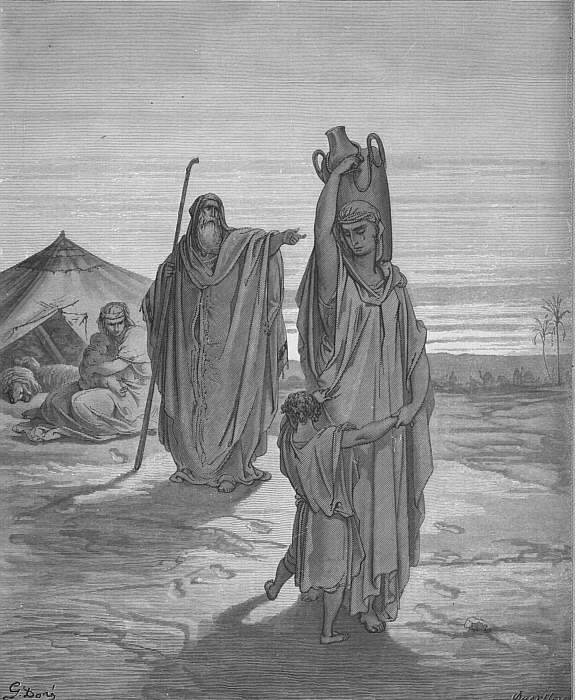
“Expulsion of Ishmael and His Egyptian Mother” by Gustav Doré
It’s been quite a while since I have written anything here, life having a way of slowing me down in my writing of late. But in the weeks leading up to Advent this year I’ve decided to write a series of poems looking at seven figures from the Bible whose lives helped pave the way for Jesus’ birth, however insignificant they seemed at the time. Today’s poem looks at one of the most significant but most overlooked figures of the Bible’s early chapters, the third son of Adam and Eve.
Seth
And Adam knew his wife again, and she bore a son and called his name Seth, for she said, “God has appointed for me another offspring instead of Abel, for Cain killed him.” (Genesis 4:25)
After the violence of my brothers -
one cursed, one buried - I was like
a quiet armistice in my mother's breath,
my name itself like breathing -
a lisping comfort,
a hush to the Earth's howling noise.


If the soil cried out for my brother's blood,
my blood flowed as a promise in my veins,
like the words my mother sang by my bed:
snakes' heads crushed, human heels bruised.

As I grew, I bruised, and I healed,
and when, a man, I held
my own child's fledgling form, I swear I saw promise pulsing in that vernixed face.
Beside the hatred of my broken race,
another story whispered.