Indecisive Spring (After W.H. Auden’s “Under Sirius”)

One of Auden’s more challenging but also most remarkable poems is “Under Sirius”, written as a response to medieval Latin poet Fortunatus who, by Auden’s account, longed for humanity to experience some sort of tragedy to shake them to their senses. Auden’s inspiration came from the time known as the “dog days”, associated with the star Sirius, in which long, languid and hot days seemed to Auden’s Fortunatus to be symptoms of the inner death of humanity. If you are living in Melbourne, you may be better able to relate to a season which can’t make up its mind, which shifts from spring to autumn to winter and back to spring again, all in the space of a few days. So I have used this Melburnian weather pattern as the starting point for my poem.


Indecisive Spring (After W.H. Auden’s “Under Sirius”)
 
             Would your hope make sense

If today were that moment of silence,
Before it break and drown…?
(W.H. Auden, “Under Sirius”)

Now, of course, we wend our way through changing days:
The sun peers sometimes out of wind
And rain and autumn cling to spring’s façade.
Sun-bakers in Apollo-worship find
Their hopes flit and dance extempore around;
Listen, listen, the silent sound
Of spring weaves in with leaves falling,
Disappointment swept up in langour
And our summer dreams ever calling.

If this is that moment of silence, it hangs between
The dog star and our torpid sun:
A quiet emptiness, a vacuum, saying, revealing nothing.
Days pass and fade, not yet begun,
And, sagging into wounded land and sea,
The Fisher King bleeds his ancient reverie;
Thunder mutters petulant
And you, Fortunatus, shake your head
At clouds both wise and arrogant.

Indecision creeps to the table; the meal eats itself;
Still the family sings and curtains sway
Into the sun long, long ago set.
And should we forget, in our vaporous way,
Who we are and what we should be,
The seasons too may fail to see
That all things wend their changing course
Yet lead soon back to always-here.
Will you, then, be watching as
The truths behind the languor finally appear?

Your answer dangles limp in the clouds,
No reason for these rhyme-and-riddle seasons.
Never fear: should spring slip into winter now,
Nonetheless the sun commits no treason.
Our orbit weaves elliptical as it’s always done
And time will know for sure what we’ve become:
Children who forgot to thank the hands
That shaped our dust and gave it lips
And made our ever-circling souls to stand.
Tethered

Last night I saw the new film “Gravity” at the cinema. If you have not seen it yet, I will not spoil the movie for you. Let me just say that it was one of the most powerful and visceral films I have seen in a long time. Coming home last night and reading Psalm 141 before bed, I found the two blurring together to form this poem – a reflection on what it means to be simultaneously bound and free.

Tethered
 
Bound by scheming foes within,
            vacuums drawing from without,
the suck of space, the pains of time,
            the memories of empty days,

entangled in these ropes and wild
            debris flying at my feet,
the looming threat of drifting free,
            no foothold and so sight:

hold me; space is vast and I
            am lost if I’m not found in You;
but I will fly tethered and free
            if I fly bound to You.

For there we hung our harps

On the poplars, drooping, drooping,
weeping in the river’s run,
there we hung our harps, no singing;
singing is now silent, dead.

The songs are gone, our tongues are weeping;
singing is now silent, dead.
Where’s the Zion of our singing,
weeping in the river’s run?

Zion is a memory, fading,
weeping in the river’s run.
Zion is in ashes, smoking;
singing is now silent, dead.

Our tongues are to our mouths’ roofs clinging,
singing is now silent, dead.
We are washed in Babel’s taunting,
weeping in the river’s run.

Give us songs; renew our singing,
weeping in the river’s run.
Breathe spirit in our music’s breathing;
singing is now silent, dead.

The Lesson (After W.H. Auden’s “But I Can’t”)

One of W.H. Auden’s greatest gifts as a poet was his versatility, being one of the major figures in the 20th century for resurrecting a wide range of traditional poetic forms. He was as comfortable with free verse as he was with long-forgotten French forms. His masterly villanelle, “But I Can’t” – an achingly simple meditation on time – is a perfect example of this. The villanelle is one of my favourite of the traditional forms, so I had fun working with this form for my response to Auden’s poem. One of the advantages of the villanelle is that the repeating refrains allow for more to be said through the form than the words themselves convey. I hope you enjoy both Auden’s use of the form and my response.

The Lesson (After W.H. Auden’s “But I Can’t”)

It doesn't pay to look too deep
If our lives will go on in their contented way;
We must learn just to breathe and sleep.

The questions that in silence creep
And nag at our minds: cast them away.
It doesn't pay to look too deep.

Graze in fields, content like sheep,
Wander, wonder, drift and stray:
We must learn just to breathe and sleep.

Time may show up the truths we keep
And make our lies as plain as day;
It doesn't pay to look too deep.

For time will run and time will leap;
What time will show, I dare not say.
We must learn just to breathe and sleep.

The answer's vague and guessing's cheap.
(If desperate, we can always pray.)
It doesn't pay to look too deep;
We must learn just to breathe and sleep.

Poems for World Mental Health Day 2013

Today is World Mental Health Day, and it’s becoming a tradition at The Consolations of Writing for me to put together a collection of 10 poems (for the 10th of the 10th) which explore mental health issues. I hope that these poems can be of comfort and encouragement. To everyone who struggles with mental illness: may God’s grace and healing be with you all today.

O My Soul – 10 Poems for World Mental Health Day

All the wisdom of Babylon

“The thing that the king asks is difficult, and 
no one can show it to the king except the gods, 
whose dwelling is not with flesh.”

They can only rearrange, those magi
whose god is their own minds. Taking what is
known already, they squint first through this eye
then that. Ask for wisdom, they will reply
as the king’s itching ear longs to hear. Ask
for revelation and they will sigh:
“What the king requires is too hard a task!”
Wisdom which struts its stuff in the street and basks
in its own sun-tanned glory has nothing
to say but theories about childhood, masks
for its own blankness. True wisdom comes right
when we’ve least reason to trust human sight.

Redress: For Seamus Heaney

The last time we were here the smell was fresh,
 The paper crisp, the window-drapes afloat.
You smiled to see the pages dance; your dress
 Swam, buoyant, triumphant on the sea. Our boat
Of words, of rhymes and stanzas, sailed atop
An ocean, swaying current - on, no stop,
 Just lucid movement; ever running run,
 The day's end fluid as it had begun.

Today the windows yawn, the curtains sink;
 The breeze goes nowhere like the stagnant page.
A pen in hand, you walk towards the wall,
 And smile to see the clouds roll back. Redress
Parts sea and sky, propulsion charged in ink.
 New words break forth in light, redeeming age,
The spirit lifting with the ocean's call.

A Better Feast

Each year I give a present and a poem to my Year 12 Literature class when they finish school. That time is approaching for the class of 2013, and I’ve had on my heart this year that the thing I want them most of all to finish school knowing is that God’s grace is the most abundant, rich blessing they can hope to find. Too many teenagers enter life thinking of God as a kill-joy and faith as a set of rules and obstacles. If I could tell my students one thing about God, it would be that He is rich in joy and love and that knowing Him is the greatest feast of all. I’ve tried to express something of this poem for my students.


A Better Feast

“Life,” they say, “is a wondrous feast,
A journey too, from day to night.
Adventuring from west to east.”

But time is short and must be seized:
“So run and dance while there’s still light.”
(Life, they say, is a wondrous feast.)

“Soon,” they say, “all things will cease;
Embrace the moment while you might.
Look, explore, from west to east

And take in all, from best to least.
Day soon fades, your chance is slight.
Quick, enjoy the wondrous feast!”

Grace, I say, is a better feast,
Eternity a grander sight;
Look, explore, from west to east –

Breath and time in Him increase
In ever-growing breadth and height:
Such life, I say, will be a feast,
When God pours forth from west to east.

Home

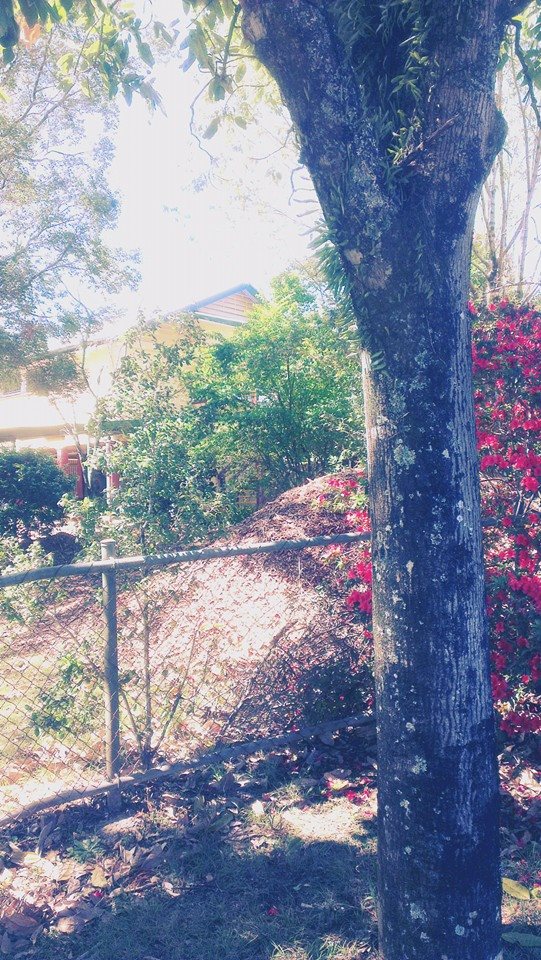
One of the stranger questions for me to be asked is, “Where do you come from?” Depending on which part of my semi-nomadic childhood is being engaged at the time, answers to that question can vary greatly. Do I say: Ballarat, where I was born, southern Queensland, where I went to Primary School, West Gippsland, where I went to Secondary School, or Melbourne, where I moved for University and have now lived for 12 years? The last week, I have been revisiting my southern Queensland childhood with my family. Today we went back to Mt Tamborine, the small town at the northern end of the Gold Coast Hinterland where I lived from ages 1 to 7, and, unsurprisingly, it brought back many memories of who I was as a child and realisations of how it shaped the adult I have become. Today’s poem reflects in a way on that, and comes accompanied with a photograph from my first school.


Home

The grass grows as you watch it;
            the soil explodes
with volcanic past, rich red
            and deep.
The trees bloom: now pink, now green,
            now jacaranda-violet;
the seasons change in shades
            of leaves
and incremental tones, the light
            dappled in the afternoon.
Palm trees sit amongst the ferns
            and I
imagine in the trunks and bowers
            of beeches, cedars,
faces of the past, of kings
            and poets, men
with dreams in eyes, their mouths
            full of thought and
full of life. The soil explodes
            with volcanic past;
the grass grows as you watch it. I
            explode with life
ahead of me; beneath my feet,
            the rich, deep earth
                        of home.

65056_10152260856108242_861641856_n

What It Is

is a giving, a direction,
            a relation to God,
a movement within the eternal.
           At His core is what we fail
to be, to do, to know.
            And so

we love to show
            what we are not
and what He is:
            relationship, community,
righteous love, perfected from
            the start,

ever true, what light years, aeons
            can’t produce
within our hearts
            of their accord:
love in the making, in creation,
            lived and breathed

            in us.