Like Love (After W.H. Auden’s “Law, say the gardeners, is the sun”)

The first of our Auden poems for the month is the wonderful “Law, say the gardeners, is the sun”, a poem that Auden wrote in 1939 around the time of his conversion to Christianity. It was famously written shortly after his profound and emphatic “September 1, 1939”, the poem he wrote on the outbreak of WWII. Where that poem made grand statements about how we “must love one another or die”, “Law, say the gardeners” was much more hesitant in tone, yet also had at its heart the same message: that the need to love openly, universally, like God, was the only way to fulfil the law at the heart of humanity. You can read the original poem here – a masterpiece of rhyme, rhythm, form and voice – and below is my response to it.


Like Love (After “Law, say the gardeners, is the sun”)
 
It hurts too much at times to try,
at times it’s easier to hide,
at times we could prefer to look
our faces in the mirror’s book
and tell ourselves that we’ve been wronged.
At times we sing our funeral songs
and make ourselves the martyrs of
our own internal cause.

At times we long for the applause
of those who watch us and declare
that all our castles of thin air
are in this land the fairest.
At times our scarcest victories
lift us up like tallest trees
and give us medals of Great Love.
At times we long for wings of doves
that we may fly away and be
at rest where love cannot be seen.
(At times we soar and leap.)

At times we see fulfilled the Law
which shows us God and our neighbor
as true love’s worthiest objects.
At times that Love takes our rejects,
and all our refuse, all our sport,
and lifts it up in heaven’s court,
the evidence that love has lost,
that none of us can pay the cost,
that only when the arms that formed
the Universe stretch out, love scorned,
and offer up this allegory,
only then can humans see

that love is worth the try
though love must make us die.
Fulfilment

He remembered us in our low estate
                      His love endures forever.
            (Psalm 136:23)

The esteem of love which esteems greatly,
           sacrifices all for the receipt of nothing,
            and gives self when Self is not
                        found within oneself;

the worth of love which bestows worth,
            values highly what is lowly valued,
            remembers what is passing, faint
                        and lost in low estate:

sing, celebrate, imitate this love,
            which loves where love is not,
            which lifts what sinks in swamp and mire;
                        and loves what it transforms.

Yet love which loves with double-tongue
            and loves that it may be esteemed,
            esteeming only when it’s loved
                        and gives to be returned,

which values what gives value back
            remembers only what clings to the mind,
            which sinks unless by others raised,
                        and affirms the fishing soul:

love is not love which alters when
            it alteration finds, nor is
            it love when with a hidden hand
                        it clutches and gives up.

Indebted to eternity, already aeons lost in space,
            beholden to a love too vast
            for any mind or hand to grasp,
                        love as you have been loved.

The law fulfilled, the highest good
            held out to you upon a tree,
            seek first the kingdom and receive
                        a love which gives as love.

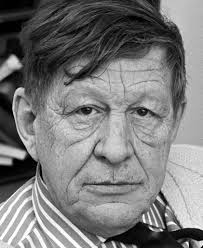
12 Poets #7: W.H. Auden

UnknownAs September draws to a close, it’s time to prepare for another poet, and I’m fairly excited about this one. When I first began writing poetry, I must admit that most of what I wrote was quite shamelessly ripping off 20th-century English poet W.H. Auden. While I’ve moved on to other poets, my years of reading and teaching Auden have stayed with me and it’s exciting to be revisiting his work. The challenge, of course, will be confining myself to only four of his poems. I look forward to sharing them with you over the month to come!

The Fig-Tree and the Worm

When complaint has its basis in the nature of the divine,
           appealing to justice and mercy and truth,
                        waiting for signs which tarry now yet
                        will come without delay,
           when complaining stands
                      at the ramparts and waits,
                      and wears as its armour thick faith,
                      then the fig-tree will bud and the olive crop soon
                                   will blossom where now it yet
                                            fails.

But you, indomitable Jonah, beneath your angry shade, are
            more my mirror. Grace frustrates you and you fly
                        against its Ninevah-bound commands,
                        to Tarshish, pride wounded,
            rebellion grounded
                        in the soil of shame,
                        and wearing the armour of Self.
                        Then the palm-tree withers and the worm consumes
                                    the shelter of deflected
                                                guilt.

Better be Habakkuk, waiting with truth, waiting expectant;
            better hope, trust and complain in the same breath:
                        for hope grows where doubt cannot fester
                        and worms eat at the dawn.
            Better confess first
                        then obey in truth, than                  
                        obey with scaly skin and forked
                        tongue (turning fists inwardly to the sky); better
                                  to trust with the rigour of
                                              grace.

Disembarking: A Terminal Sonnet

Bad coffee drunk at airport terminal's
 Faint consolation for delays in flight,
 When failing air-con gives pilots a fright,
And back we go to slow departure halls,
Disembarking and delayed. It's small -
 A First World problem, as they say; tonight
 I should still be in Queensland: when all's right
With aircraft safety, we'll still soar, our tall
Tales told of men with wings made strangely true.
 Yet now it seems the worst fate for today
 For all things should always go our own way;
What apps can't fix, the human mind must rue.
 (I'll take for granted when the plane takes off
 And rail inside at my companion's cough.)

Immanence

What churches, prisons, feudal pyramids
 Possess in common is Authority.
Only the state's power, not the State, exists,
 And power is exchanged through you and me.
Our eyes, transfixed by prison walls, confuse
 The institution with the power it holds
Mixing correct use up with the abuse
 And sovereign love with the despot who scolds.
The immanent passes always before
 Unseeing eyes; it moves within our spheres
Yet renders false our thoughts of love and law.
 For complexity is not as it appears;
We see only power and lines of flight,
But curving through it all, the living Light.