Michelangelo Merisi di Caravaggio, “Madonna dei Palafrenieri” en.wikipedia.org
Is there any way to escape punishment and be brought back into God’s favour?
Yes, to satisfy his justice, God himself, out of mere mercy, reconciles us to himself and delivers us from sin and from the punishment for sin, by a Redeemer.
The words of the wise are as goads, and as nails fastened by the masters of assemblies, which are given from one shepherd. And further, by these, my son, be admonished: of making many books there is no end; and much study is a weariness of the flesh.
(Ecclesiastes 12:11-12 KJV)
The teacher searched to know and understand all wisdom and folly. In all his studies, he saw history repeating and the goodness of the wise being thwarted by foolishness and by the pervasiveness of evil under the sun. The same fate overcame both the wise man and the fool. And so, he asked, what profit was there in all this toil? Why did the wise man labour when he suffered the same fate as the fool?
Here, in his summation of all that he has found, the writer of Ecclesiastes declares the study of books to be a weariness of the flesh. The Hebrew word for “weariness” which he uses – yegi’ah (יְגִיעָה) – has an interesting context to it. The word itself appears only here in Hebrew scripture, and its Greek equivalent – κόπωσις or koptó, used in the Greek translation of the Old Testament and in a number of New Testament passages – denotes lament, mourning, or cutting off. Yegi’ah, however, is related to a group of Hebrew words which can variously be used in relation to toil, labour or weariness. The root word, yaga, appears for instance in Ecclesiastes 10:15 when the writer declares that “a fool’s work wearies him”. The same word is used when Job laments, “Since I am already found guilty, why should I struggle in vain?” (Job 9:29). David uses the word when he declares that he is “worn out” from his “groaning” (Psalm 6:6) and elsewhere when he is “worn out calling for help” (Psalm 69:3). Isaiah uses it repeatedly when he tells Israel that God will not “grow tired or weary”, that He “gives strength to the weary” and that “those who hope in the Lord…will run and not grow weary” (Isaiah 40:28-31). Yet, when Israel does not seek out God, they are said to be have not “wearied” themselves for Him, and God is later said to be “wearied” by their “offences” (Isaiah 43:22, 24).
Most interesting, perhaps, is the use of the word yegi’ah outside of the Bible. It appears in extra-biblical Jewish writings as one of the ways in which the Torah can be read or studied: formal, intensive study, as opposed to cursory reading. Some Hebrew and Christian commentators have interpreted Ecclesiastes 12:12 to be a warning against the reading on non-scriptural texts. Amos Bitzan, in his dissertation on pleasurable reading in Jewish thought, quotes a passage from the Talmud Yerushalmi which refers to the often-cited statement by Rabbi Akiva warning that “one who reads in external [ie. non-Biblical] books” shall not “inherit the land” as per Isaiah 60:21. Yet the rabbinical injunction against external books was not universal: some noted that such books “were given for recitation not for tiring study [yegi’ah]”. In this sense, exhaustive study of Biblical books was not wrong, but it was when such study was exercised with non-Biblical books.
My mother, I remember, used to remind me of Ecclesiastes 12:12 when I was completing my Honours thesis in Literature. She was not, I suspect, viewing the passage in light of this school of Jewish thought, yet was warning that too much study could be an exhausting experience. This view is not, I suspect, altogether separate from what the writer of Ecclesiastes was saying. A book which has been famously hard to locate comfortably within the flow of Hebrew scripture, Ecclesiastes is not perhaps as opposed to non-Biblical learning as some try to make it to be. Indeed, some view the book as a kind of thought experiment – an examination of the world through secular eyes – a process which is given an inexplicably large space in the Bible if its only conclusion is that secular wisdom is destructive and to be avoided at all costs. Yet such “wisdom”, apart from God, is clearly not liberating. If the toil that is placed in studying scripture gives life, the toil of studying the many books which the world produces is only going to be like the other forms of toil which the Teacher decries:
What does man gain from all his labor
at which he toils under the sun?
Generations come and generations go,
but the earth remains forever. (Ecclesiastes 1:3-4)
The word for “toil” used here is a different Hebrew word, yet it has similar connotations, also used throughout the Old Testament to denote both toil and weariness. The weariness that comes from the mind studying may not be the same as that which comes from physical toil, yet each leads to the same end: the futility, the vapour or vanity which the Teacher finds everywhere he looks.
*
A former student of mine, now studying at University, asked me a few years ago why so many academics seem depressed. The reasons, of course, could be many, but Ecclesiastes’ Teacher could tell us some of the reason why. New theories are developed, new ideologies and epistemologies circulated, yet they fail to transform or change the fundamental hardships of this life. Academic endeavour, the accumulation of knowledge, the development of theories: all of these are, in the end, wearisome, if they cannot push beyond the entropy of the human state.
Some in this world believe that, if God exists, He should be understandable and accessible via human reason. That may be. Yet the end-point of the weariness discussed in Ecclesiastes is not our arrival at some transcendent epiphany but one of broken humility before a transcendent God. This is something which is arguably aided, not prevented, by mental illness. Some of the most intelligent people throughout human history have been beset by deep sadness, weariness or anxiety – sometimes because of their great learning. Some have reached an intense point of crisis precisely because their learning only brings them ever more profoundly to its own impasse; and some of the world’s most significant changes have been accomplished at this point of crisis.
Yet what is accomplished on a large scale in some cases can occur in a smaller day-to-day sense in each life, when we recognise that, for all we know, we are not God and our knowledge can only perpetuate and re-interpret what already is until we encounter and humble ourselves before the God who Is.
Intellectual endeavour may enable us to understand the workings of the human mind, and many have been blessed by what psychology, psychiatry and neuroscience have taught us. When I read the stories of significant believers in the past who experienced mental illness, some cry out for the kind of care which they would have received had they lived today. William Cowper’s story, for instance, might have been a far happier one had his particularly intense form of paranoid depression been properly diagnosed and treated; yet perhaps his hymns would not have impacted as many lives with their raw emotional faith if that had happened. Martin Luther would perhaps have been better able to manage his guilt complex with the help of modern psychotherapy, or reduced his compulsive confessions if he had received Cognitive-Behaviour Therapy; yet perhaps the European Reformation would not have happened, or would have taken a very different direction, if this had been so. John Bunyan might have wrestled less with thoughts of intense blasphemy and destructiveness had he learnt better strategies for confronting and resisting them; yet the world would not now have Grace Abounding to the Chief of Sinners or, more significantly, The Pilgrim’s Progress.
We cannot know how these figures’ contributions might have changed had their mental illnesses been treated by twenty-first century standards, and in some ways it is futile to consider what might have been. The key truths that we can learn from these lives are not techniques for reducing mental distress but for knowing how to take such distress and the deep sense of futility in human endeavour that it brings and present it before God.
*
I vividly remember the night that a friend told me I no longer needed to comfort myself with my own mind, that God wanted to be my comfort. I lay in bed and prayed Psalm 131 to myself: My heart is not proud, Lord, my eyes not haughty. I do not concern myself with things too great or wonderful for me…That, I remember, was the start of a significant change in my mental health.
In a world which values intellectual toil so highly, to accept that such toil is, in the end, weariness of flesh without God is humbling and counter-cultural to say the least. Yet it may be the only way that we can escape the cycle of toil and weariness which fills this world. For many in the past, it was the only way to escape from the terror of sin and death which consumed them; and we will turn to some of their stories now.
References
Bitzan, A. 2011. The Problem of Pleasure: Disciplining the German Jewish Reading Revolution, 1770-1870. Doctoral Dissertation, The University of California, Berkeley. http://escholarship.org/uc/item/20c378fm
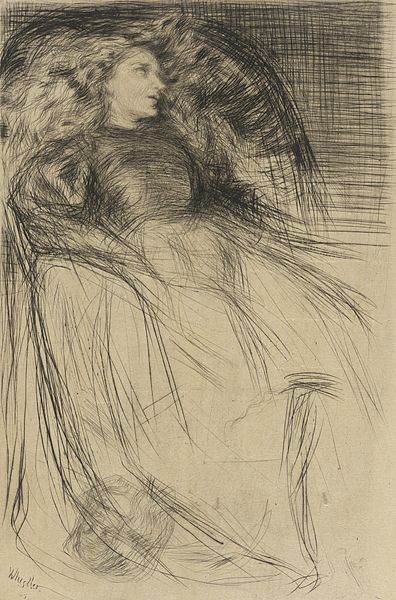
“Le Sommeil” by Alphonse Eugène Félix Lecadre vintageprintable.com
Yesterday I posted a poem based on the beautiful Psalm 131. It is one of the shortest psalms in the Bible, yet one which I have found particularly comforting at times of emotional and psychological distress. Today I am posting a recording I have made of a new musical setting of Isaac Watts’ hymn based on the same psalm. Here are the words to Watts’ hymn so that you can read them along with the recording. May it be a reminder of the stillness that we can have in the arms of an infinitely loving God.
Is there ambition in my heart?.
Search, gracious God, and see;
Or do I act a haughty part?
Lord, I appeal to thee.
I charge my thoughts, be humble still,
And all my carriage mild,
Content, my Father, with thy will,
And quiet as a child.
The patient soul, the lowly mind,
Shall have a large reward:
Let saints in sorrow lie resigned,
And trust a faithful Lord.
My king, the heavens were your throne, your seat.
The task beneath us, we shuffled in our pride;
All things beneath you, you God washed our feet.
Undignified, so lowly, indiscrete! What, Rabbi, wash our feet? we all decried.
My king, the heavens were your throne, your seat…
With thrones to claim and enemies to beat,
The servant’s towel the victory robe you tied;
All things beneath you, you, God, washed our feet.
Reclining in our comfort, souls replete
With motives mixed and dull, we turned aside…
My king, the heavens were your throne, your seat.
The lord of all now redefining great –
What did such love demand? Our status cried.
All things beneath you, you, God, washed our feet…
The shame of it, the love now made complete:
This utmost-love of nails and pierced side.
My king, the heavens were your throne, your seat:
All things beneath you, you, God, washed our feet.
Some years ago, the greatest comfort I found in the Bible was in the book of Ecclesiastes. This may sound strange to some people: it is hardly most people’s first choice for scriptural encouragement, with its repeated catch-cry variously translated as “everything is meaningless”, “everything is vapour”, or “everything is vanity”. Yet I remember nights when all I could read to help me sleep was this book, sometimes considered either the most depressing or most existential work in the Bible. If you look for the closest thing that scripture has to twentieth century philosophy, you will find it in the book of Ecclesiastes: curious, perhaps, but what is likely to be comforting in this?
Well, first of all, it needs to be said that I was not the first to be comforted by it. Throughout history, believers struggling with what is now termed “existential depression” – a sense of weight, of languor, of despair, over the nature, structure and meaning of life – have strangely found comfort in Ecclesiastes. Victorian poet Christina Rossetti, a devout Christian who still struggled with melancholy and sickness for much of her life, turned to the book in a number of poems, including the sonnet “The One Certainty”, “A Testimony” – written from the perspective of Ecclesiastes’ unnamed “Teacher” – and even wrote a book on the subject, entitled Ecclesiastes, or, The Preacher. Rossetti seems to testify to what I too found two years ago: that it is comforting to see melancholy, disquiet, existential depression reflected in scripture. It makes us feel less alone, less like the Bible is a theoretical work that knows nothing of our sorrows.
Rossetti’s journeys into Ecclesiastes are among some of her bleakest, since she refuses the kind of comforting answer that we might feel forced to impose upon the book. Yet the bleakness of Ecclesiastes, and of Rossetti’s poems, is one which forces us to look elsewhere. If it is ultimately disquieting, it is because we still live in the “evil under the sun”. We witness the same cycles over and over again; we feel the weight and weariness of our flesh; we see others prospering from that for which they did not labour; we are never satisfied:
The earth is fattened with our dead;
She swallows more and doth not cease:
Therefore her wine and oil increase
And her sheaves are not numberèd;
Therefore her plants are green, and all
Her pleasant trees lusty and tall.
Therefore the maidens cease to sing,
And the young men are very sad;
Therefore the sowing is not glad,
And mournful is the harvesting.
Of high and low, of great and small,
Vanity is the lot of all.
A King dwelt in Jerusalem;
He was the wisest man on earth;
He had all riches from his birth,
And pleasures till he tired of them;
Then, having tested all things, he
Witnessed that all are vanity. (Rossetti, “A Testimony”)
Where, then, do we go with this disquiet?
Ecclesiastes itself provides a number of answers, though sometimes we have to look carefully for them. The first comes in what is perhaps the most famous and most often-quoted passage from the book – the third chapter, with its memorable poem about the seasons of life, famously set to music by the Byrds. Within this series of declarations of what different seasons life affords, there is the statement that there is “a time to weep and a time to laugh, a time to mourn and a time to dance”. Note, these seasons, though contrasting, are given equal weight. They are, seemingly, as important as one another, as much a part of life. Indeed, while we may struggle with some of the contents of the chapter – a “time to kill”, for instance – we must recognise that there is manifold complexity to the fabric of life which we, not being God, fail often to understand. Wisdom literature, with its emphasis upon “the fear of the Lord”, contends that the best place to start is to acknowledge our inability to understand what only God can truly hold together. Therefore, we can strangely take comfort in seasons, because all seasons are ordained by God and have their purpose – “and God will call the past to account”.
The second answer comes two chapters later, when the Teacher, having just criticised those who labour for their own advancement, turns to God’s majesty and our weakness before Him:
Do not be quick with your mouth,
do not be hasty in your heart
to utter anything before God.
God is in heaven
and you are on earth,
so let your words be few. (Ecclesiastes 5:2)
The answer, then, to the weight of existential depression? Mourn. Recognise your own lack of understanding and stand trusting before God. Recognise the seasons, and their value. Let this be a season of mourning, and rejoice that God ordains other seasons.
In the end, this is not, perhaps, an answer. Those wrestling with the apparent meaninglessness of life may not necessarily be comforted immediately to know that there is not a clear answer to the problem. Yet it is indeed comforting to know that God holds together what we cannot possibly understand.
The book of Ecclesiastes, for me, is comforting for a similar reason to why I find the Psalms comforting. It reveals life’s complexity, its many pleats and colours, in a way which ardent declarations of faith, however well-intentioned, cannot always do. And, revealing that complexity, it tells me to stand trusting before God. If this is a time for mourning, then mourn. But trust that God sees more than I see, and trust that He will call all things to account.
It takes weariness with life to write a book like Ecclesiastes. And it also takes a deep, abiding knowledge of our Creator, which can only come from acknowledging life’s pain, mourning it with Him and, in the end, standing in awe before Him.
References
Rossetti, C.G. Goblin Market and Other Poems. http://ebooks.adelaide.edu.au/r/rossetti/christina/goblin_market/contents.html




 The Consolations of Writing