From Ashes Part 1: Melancholy and Silence

"Melancholy" by Lucas Cranach the Elder Wikimedia Commons
“Melancholy” by Lucas Cranach the Elder
Wikimedia Commons


When I announced, both on my blog and on Twitter, that I would be writing a series of pieces on significant Christians’ struggles with mental illness and asked for suggestions, I had thought I was onto a good thing. I had in mind as a starting point the stories which had brought me great comfort in my own struggles: of Luther’s and Bunyan’s journeys through conditions strongly resembling my own illness, obsessive-compulsive disorder, or of Kierkegaard’s long-term battles with anxiety and depression; of Therese of Lisieux’s discovery of the “little way” through her own struggle with OCD (or “scrupulosity”, as it used to be called); of Spurgeon’s famous “fainting fits”.

Yet surprisingly the response my call for help received was sparse. I received a detailed list from one of my regular readers, and tweets from two church friends. In most cases, the suggestions – though helpful and much-appreciated – only confirmed the figures I was already familiar with. My discussions with colleagues at the Christian school where I work were less helpful. One colleague told me about William Carey’s first wife “going loopy”; a friend who trained in psychology said he was unaware of anyone.

Scans online proved more productive; a number of lists can be found, though these tend to recirculate the same names as one another. A handful of contemporary figures have had the courage to share their struggles, mega-church pastor Rick Warren and singer-songwriter Sara Groves among them. Yet in many cases I needed to look further, following hunches that particular people must have experienced struggles, sometimes confirming these hunches, sometimes finding the Internet altogether silent.

We must, of course, be wary of posthumous diagnoses. Conditions like bipolar disorder and OCD were unknown until relatively recently and therefore we have no official diagnoses for any of the famous figures believed to have suffered from them. Yet there is more than an historical problem at work here: quite apart from the difficulty of identifying which now-deceased celebrities struggled with what we would now call “mental illness”, there is simply the fact that churches have themselves struggled to acknowledge such kinds of illness and take them seriously, both in the past and in the present. In the past, this was partly due to a lack of medical knowledge: what we can now state about the chemical workings of the brain and its connection with psychological distress was simply unknown at the times that many of these figures were alive. Yet it does not fully explain the problem. After all, we now know much more about mental illness; yet in so many cases the silence continues. What, we must ask, does the church have to say about it today? How do Christians deal, privately and publicly, with their struggles?

This is a bigger problem perhaps than I can address here. Instead, I intend to offer a small step in the right direction: to examine the ways in which probable mental illnesses impacted upon the lives and ministries of many significant Christians. The value in this project is at least threefold. First, it can help to dispel the myth that “serious Christians do not struggle with mental illness”. Second, it can help those of us who struggle to feel less alone. Third, it can offer examples for us of how the church has benefited from Christians with mental illness. In many cases, in fact, it is arguable that the contributions made by these figures would not have happened had it not been for their own “dark nights of the soul”. Some are artists, some composers, some writers, some theologians or philosophers. All are known for their creativity, whether artistic creativity or innovation or reformation in how we think and act in our faith. How mental illness served as a catalyst for this creativity is something which I hope will emerge helpfully from their stories.

The story so often begins, however, with silence: with an agonising inability to express the hidden griefs of the soul; a conviction that it should be otherwise but a dread that it cannot; an angel – as Lutheran painter Lucas Cranach the Elder represented it – unable to fly, confined to pushing leaden balls through hoops while clouds gather outside.

Where, sitting sympathetically with the burdened ones, can we go from here? How can we move from this leaden silence to a place of creativity and hope? The journey is one that must be taken together if the silence is to be overcome.

Easter Thursday

And He reigns!

He reigns in light and in quiet,

in death and in life,

in depth and in height.


He reigns in plenty,

He reigns in drought.

He reigns in our faith, reigns in our doubt

and nothing is too big for Him

who rose from death a shining King…


Put to death your anguished griefs:

the king who died now lives again

and all time’s tattered woes and fears

can no longer bind His faithful sons.

Easter Wednesday

Some wise men follow, some betray;
some see the star, some walk astray.
Some kings will bow, some kings will kill;
some men will starve, some have their fill.
Some hearts will turn to rock; some stones
will call in praise before His throne.
Our folly becomes wise in Him;
bow down, world’s wise men; know your king.

(Image: Sassetta Giovanni, “Journey of the Magi”)

Easter Tuesday

800px-STP-ELP19

It shatters; it transfigures:

from dust, His kingdom

lifts up dust, exalts our frame,

remembers, changes, in His name,

breathes new life into dry bones,

reanimates the dead.


Eleven dusty men, arise:

the mountain-top reveals your king.

All authority given Him,

He gives to you. Lift feeble feet;

He gives His message now to you.

The kingdom – shout it! – now is here.


Amidst the dust of here and now,

be its hands and feet.

Catechism 16

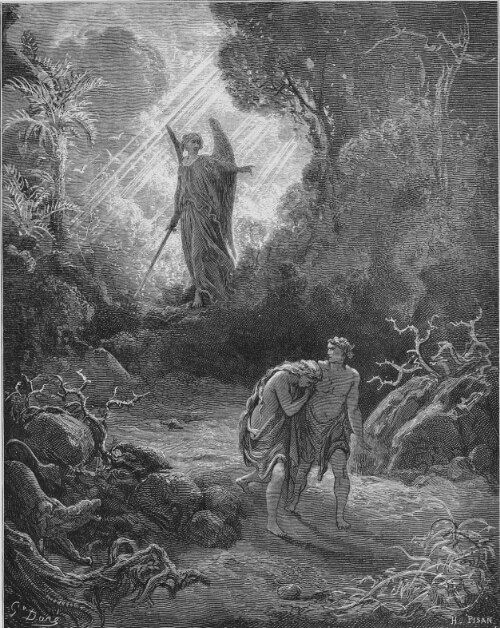
Gustav Dore - Exile From Eden
Gustav Dore – Exile From Eden

What is sin?
Sin is rejecting God in the world he created, rebelling against him by living without reference to him, not being or doing what he requires in his law – resulting in our death and the disintegration of all creation.
(New City Catechism)

The choice of the moment:
a hand to reach out and pluck
or hold, be still, believe.

The friction of the heart:
denying the Maker’s wisdom,
requiring yet still rejecting.

The pride of the decision:
as though lungs refused air
or ground denied gravity.

The destruction of the act:
earth dries, flesh rots,
equilibrium tears and breaks.

The coldness of exile:
knowledge gained, rejection done,
yet victory hollow and dead.

Easter Monday

800px-Eriogonum_pyrolifolium


The priests conspire. Money changes hands.

Even still, the truth must be buried in dark.


And yet it bursts forth. Indomitable, it rises:

a spring-bloom which cannot be killed…


When the first-fruits sprout, the harvest follows.

The best-laid plans of priests and men


cannot contain what God has raised.

See, it shatters every earthly tomb.

Easter Sunday

Gustav Doré http://ebooks.adelaide.edu.au
Gustav Doré
http://ebooks.adelaide.edu.au

Rock-hard hearts: stone rolled away;
see God shake us in His way.

Unseeing eyes: look and know;
cast off doubt at heaven’s show.

Fearful feet: stop and see
the empty tomb, the mystery.

Dust-born flesh: He knows and heals.
The heavens ring with Easter peals…

And all our stony, ashen flesh
is changed now in His endlessness.

Lent 46: Holy Saturday

Detail from Alexandre Bida, "Joseph of Arimathea Prepares Jesus for Burial" http://www.gci.org
Detail from Alexandre Bida, “Joseph of Arimathea prepares Christ for burial”
http://www.gci.org

Down, they took his body down;

Joseph, Nicodemus took

him to the tomb reserved for him

and soldiers stood and watched.


There they stood; the soldiers stood,

to see what ruse might there unfold.

suspicious, victory not quite won,

the soldiers stood in wait.


Dark took hold, the sky asleep,

the faithful in their hiding holes,

only women weeping, with

firm vigil in their hearts.

Lent 45: Good Friday

The Darkness at the Crucifixion - Gustave Doré en.wikipedia.org
The Darkness at the Crucifixion – Gustave Doré
en.wikipedia.org

They took him down to Golgotha,

to Golgotha, the place of skulls;

they set him in between two thieves

and hurled disease on him.


They struck his face and speared his side

at Golgotha, at Golgotha;

they called him king and laughed at him

and cursed him on the tree.


The earth, it shook at Golgotha,

at Golgotha, the place of skulls;

the dead arose, the sky was dead

and soldiers stared at him.


They said he was the Son of God,

at Golgotha, at Golgotha;

he bled and died at Golgotha,

accursed, upon a tree.

Lent 44: Maundy Thursday

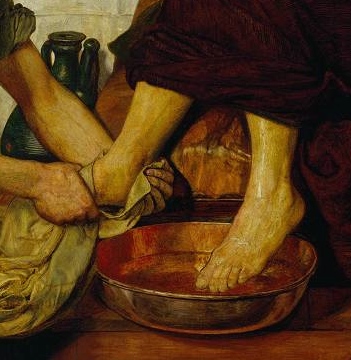
Detail from Ford Madox Brown, "Jesus Washing Peter's Feet", Tate Online
Detail from Ford Madox Brown, “Jesus Washing Peter’s Feet”, Tate Online

A new command I give to you

High Priests gather; darkness looms

That you love as I’ve loved you

Pilate’s wife now dreams…


Love your enemies and pray

Judas gives back bloody coins

Blessed are the merciful

The High Priests buy a field


This is how all men will know

Pilate struts; the people shout

That you are all my followers

Judas hangs in shame.


If you have love, one to another

“Shall I give him back to you?”

A new command I give to you

“Crucify!” they scream.