Well, our month of looking at George MacDonald is now finished, and to conclude it here is an essay I have written on MacDonald’s work. We have been focusing here through August on MacDonald’s poetry, but his work was far broader than that, so this essay considers not only his poetry but also his many works of fantasy and criticism. I hope it can give you all an interesting entry point into the richness of his work as a writer.
Run Run Ever (After George MacDonald’s “No End of No-Story”)
The first thing I ever read by George MacDonald was his most dreamy children’s novel, At the Back of the North Wind, a book which compelled me as much as it mystified me. I remember vividly the moment that I encountered the poem, sometimes entitled “No End of No-Story”, which appears in the novel – a strange, lullaby-like song which the main character, Diamond, heard on one of his journeys to the back of the North Wind. It is not perhaps one of MacDonald’s finest poems, yet it had a powerful effect on me when I first read it, and so I have tried to create some of that same effect with my own poem here.
Run Run Ever (After “No End of No-Story”)
“It’s such nonsense!” said his mother. “I believe it would go on for ever.”
“That’s just what it did,” said Diamond.
“What did?” she asked.
“Why, the river. That’s almost the very tune it used to sing.”
(George MacDonald, At the Back of the North Wind)
When we
tired ones
reach the
river
we will
sit by
its soft
streams and
see the
city
it makes
glad with
all its
streams and
all its
flowing,
see the
city,
see the
lamb whose
light is
now the
light of
living,
and we
will not
mourn for
dying
or wish
we were
back in
shadows
but, once
dreaming,
we now
wake to
find the
brightest
morning
where our
dreams prove
pale and
dying
and our
doubts are
swept a-
side in
days of
brightness
by this
ever-
running
river
Memento Mori
Tenth birthday, and the Titanic sinks
On a screen, the largest in
The southern hemisphere,
Drifting down beneath the waves,
Wreckage waiting, submarines
Plumbing depths to find its jewels,
Then sunlight after deep marine,
The exit into daylight scenes
And Dreamworld rides and cake,
With me, crestfallen, eagerness
Sublimated in this breeze,
This vapour recognition.
Sowing (After George MacDonald’s “Better Things”)
Like many Victorian poets, George MacDonald often wrote poems which were far longer than they needed to be and far more flowery than readers today are comfortable with. But when he succeeded with a poem, he really succeeded, at his best when his form allowed for a simplicity and crispness of language and imagery that could be particularly powerful. An example of this is the delightful poem, “Better Things”, a series of poetic proverbs which emphasises simplicity, faith and humility above all else. I’ve used this as the basis for my own exploration of two verses from the book of Proverbs. I hope you enjoy both my poem and MacDonald’s.
Sowing (After “Better Things”) Better is open rebuke than hidden love. Faithful are the wounds of a friend; profuse are the kisses of an enemy. (Proverbs 27:5-6) Guard your hearts for kisses spoil; Hidden love won’t die. Keep your dreams safe from the storm And save yourself in pride. Shield yourself from honest friends And know the lies of foes; Second-guess your blessings and Multiply your woes. Trust the lips of enemies But fear the truth that sees; Hide yourself and be unknown And stifle all your pleas. Or love and hazard everything; Know, be fully known. Give all in this harvest hope And reap as you have sown.Nature Boy
They say he wandered very far
And left his home behind;
They say he gave up kings for fools
And land for tides and sea.
They say he wandered ‘til he found
A tree to make his throne
And searched for friends who would betray
And lost ones who would run.
They say he gave up all he had –
The heavens and the earth –
To take his place, gasping for air
And thirsty to the bone.
They say that as he breathed his last
He looked on what he’d made
And seeing how his love dispersed
Asked nothing in return.
And when one day – one magic day –
He passed my way, we spoke
Of all that he had learnt and known
And all that I must know.
He showed me scars within his palms
And as we spoke he wept.
The greatest thing you’ll ever learn
Is just to love, he said.
Fragments of a Prayer (After George MacDonald’s “A Broken Prayer”)
I’ve been slipping behind a bit in my poetry project this month. There’s been a lot going on in my life! But it’s time to start catching up. So today I’m looking at one of George MacDonald’s most complex but also compelling poems, “A Broken Prayer”, a poem written in a hybrid of free and blank verse which contains some of his most striking imagery of faith. You can read MacDonald’s original poem here, and here is my response to it.
Fragments of a Prayer (After “A Broken Prayer”)
O Lord, my God, how long
Shall I fret with striving and with anxious joy?
How long, great King, will I stomp at Your throne,
Sure within myself that I know best,
A child prince with petulant demands
While You patiently reign, grander plans at hand?
I take Your gifts and clutch them to my chest,
Afraid of vapour, fearing fading dreams;
The future, vacuum-like, ushers me in,
Yet I cannot see it with my haughty eyes
And so I turn my gaze towards myself.
I would be a child
Resting at Your breast, no longing, no pride,
But the smallest quake of earth, each gust of wind
Sends me searching for the shadows where I wait,
Mementos and anticipated futures in hand,
Clinging to whatever I can hold,
Afraid that You are not found in the storm.
Most mighty One,
Take my best thoughts, my best moments,
Multiply them in Your soil; make me a harvest
Of Your grace and truth, at work in every field.
The grandest tree grown apart from You cannot know
The life that bursts from Your ground, revives
The driest trunk, the feeblest stem; it lives
But if it breathes not You, it does not breathe.
O Lord, take
My weakest striving, my haughtiest dreams;
Take my stem which writhes away from You.
Take my fears and my self-sufficiency
And graft me into You.
Australian Christian Literature Awards
Last night SPCKA (Society for Promoting Christian Knowledge Australia) hosted the annual Australian Christian Literature Awards, which I had entered this year, submitting a collection of my poems for the Young Australian Christian Writer Award. Amazingly, I won! It was a truly humbling experience to receive the award, and I’d just like to publicly thank all of you for reading and supporting my work. Most of the poems that I submitted were first shared here, and if it hadn’t been for everyone’s wonderful encouragement of what I write, I doubt I would have had the confidence to submit them for the competition. So thanks for your support and for being wonderful readers! I can’t wait to see what God has in store for the future.
The Fledgling (After George MacDonald’s “Diary of an Old Soul”)
One of the most powerful and touching works that George MacDonald wrote, although also one of his least known, is his sequence of poems entitled, a little awkwardly, “A Book of Strife in the Form of the Diary of an Old Soul”. The book includes a poem for each day of the year, each one seven lines, varying delicately in rhyming scheme, sometimes varying in quality, but always confronting the challenges of life-long faith and the realities of doubt and despair, while always finding hope and comfort. It is well worth the read. Here is my first George MacDonald-inspired poem, a group of four seven-line stanzas inspired by MacDonald’s January poems.
The Fledgling (After George MacDonald’s “Diary of an Old Soul”) I. Doubt keeps me static, safe inside my nest. The swaying branches threaten from without, Yet wings are still too downy; it is best To stay inside and settle in my doubt. But faith has winds too, blowing as I wait; A voice too beckons me to venture out, For waiting I am weighty, without flight. II. The wind has echoes in these silences; I look for arms to guide me as I fly, Yet nothing holds me but this thorniness, While other flocks fly, apathetic, by. If I should spread my wings, would this thin breeze Have strength enough to hold me, floating high? I fear the heights of mountains, depths of seas. III. The air is still; the yearning spirit sighs. My doubting feathers wait for time to come. But in the silence, there is one who says, “Don’t wait. In flight, learn who you have become.” Because you are my life, my feathers rise; Because your love is good, I soar to sun; I can, I must fly hopeful in your skies. IV. Look on me now and see, men on the land, Look on my wings, my flight; look on and learn: See how I fly, how I am fed by hands Which made and formed my feathers and each turn, Each gust of wind which holds me in his plans. Take doubt, you winds, and turn it into flight; Take flight, faint heart, and soar by faith, not sight.The Crowd Is Unbelief
For up they looked and on they walked, straight to
Horizons which the world, too blind to see,
All mocked and doubted; yet the endless view
Of cities yet to come, lives yet to be
Still drove them on, amidst the scornful crowd.
The leap of faith, the movement and the dance,
The downwards stab which scandalised the proud –
All this defied the pomp of circumstance
Yet showed them what one day could be by faith,
Gave eyes to see what could not yet be seen,
Gave spring to steps, to fall out into grace,
And confidence to stand against the mean.
The world, not worthy of them, shakes its head;
The faithful, trusting, take the leap instead.
12 Poets #5: George MacDonald
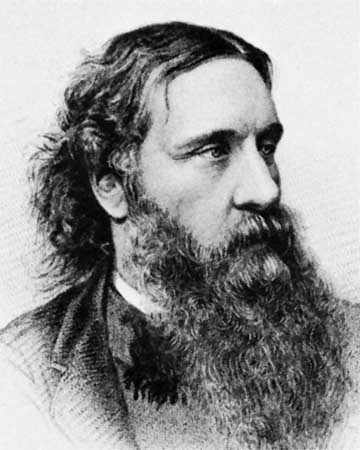 Well, it’s time sadly to say goodbye to Christina Rossetti, but also time to say hello to a new poet. This month we will be looking at another great Victorian writer, the Scottish novelist, preacher and poet George MacDonald. MacDonald is more famous perhaps for his fantasy novels for children, but he was, like most Victorian writers, extraordinarily prolific, producing reams of sermons, devotions, realist novels, essays and, less famously, poems. So this month we will go on a journey of discovery through his poetry. Who knows what we will find. I hope you can all join me along the way.
(Image: http://www.george-macdonald.com)
 The Consolations of Writing