
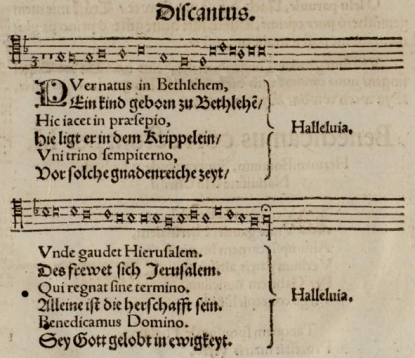
On the ninth day of Christmas, apparently, someone’s true love once gave them nine ladies dancing. Impractical though this is as a Christmas present (not to mention hard to wrap), it suits today’s carol well: the majestic “In dulci jubilo”, set by the seventeenth-century German Lutheran composer Michael Praetorius. The story of the text, originally written by 13th-century German mystic Heinrich Suso, is a story of dancing being brought into the midst of grief. According to the (auto?)biography of Suso, The Life of the Servant, Suso was told by an angel to stop the intense mortifications that he was practising and instead to join the angels in their dance: “Now this same angel came up to the Servant [Suso] brightly, and said that God had sent him down to him, to bring him heavenly joys amid his sufferings; adding that he must cast off all his sorrows from his mind and bear them company, and that he must also dance with them in heavenly fashion. Then they drew the Servant by the hand into the dance, and the youth [angel] began a joyous song about the infant Jesus, which runs thus: ‘In dulci jubilo’, etc.” It may or may not be a true story (more about the fascinating life of Suso can be read here), but the f
act remains that a man known for his austere ascetic practices also gave the medieval church one of its most joyful hymns. Today’s poem is inspired by Suso and the angel’s words.
Join the dancing
Angels dance around the stall.
Sing! Sing! One and all.
Come to earth, enthroned in hay,
sleeps the shining, living Day.
Leave your grieving songs, your weeping.
Dance, dance, with angels leaping.
Though the darkness now may linger,
Heaven dwells within a manger.
Cast off your ashes and your sackcloth.
The king is resting in a food trough.
Nothing now can snuff his light.
Sing, dance, with all your might.

 2017 is almost over, and today we have two choral pieces to conclude our year with, one early, one modern, both settings of one of the readings for the first Sunday after Christmas, Isaiah 61:10-62:4. The first is the delightfully joyous “Gaudens Gaudebo in Domino” by the 16th century German composer Philip Dulchius. The text comes from the opening to the song, “I will rejoice greatly in the Lord”, which Mary echoes in her Magnificat in Luke’s Gospel. A modern reimagining of this text is the late Norwegian composer Knut Nystedt’s beautiful “I will greatly rejoice”, similarly jubilant but with simpler harmony. Both settings, looking not only to our own salvation but the saving of all nations, are wonderful calls to praise and prayer at the end of 2017.
 Today’s reading tells the story of Jesus being presented to Simeon, the faithful follower of God who had waited in expectation of the “consolation of Israel” for all of his life and could now be “dismissed in peace”.
 The Consolations of Writing