While my body silent lies, May Thy power keep vigil; Let my sleep in Thy presence Be like the rising incense.
(St Ephraim the Syrian).
What can we offer?
The day is proud in its confidence;
night is helpless.
If they come, our shelters are weak,
our bags packed, our feet ready –
yet the shadow shelters too, here and in exile,
and the silent vigil is constant.
From threats which stalk without, within, we are kept:
though we are as mud-drops in an ocean,
the ocean protects.
Unknown the direction, unseen the foes;
yet we drift – tonight, tomorrow – in You,
sea of mercy, protecting light,
everything when nothing.
No flights to Damascus
and if there were
Safety would fly in the face of Intention.
Where knowledge is danger, is ignorance bliss?
I cannot walk Straight Street and know the vision
that blinded Saul, or see the home
where scales fell from well-meaning eyes.
That much is past; no flights can take me
where not even the locals go.
And would I even know, if by
some sudden wind, I found myself
on cobbled stones of Sunni blood,
and if I saw where churches fell
and watched the flight of history –
what could I know? What Qantas knows
is where the terminals make way,
not who lost home or who lost hope
or where the life is found.
This day are opened, our mouths to give thanks. They who opened the breaches, have opened my sons’ mouths.
(St Ephraim the Syrian, The Nisibene Hymns)
The night begins our day; we raise
our open mouths to praise.
The sky
falls in orange sleep, but wait
expectant of the dawn.
The gates are breached; the night is deep.
The wall is broken so we reach.
You took our king to make us kneel
and rent the sky to make us gape.
The night begins the day; we raise
our gaping mouths to pray.
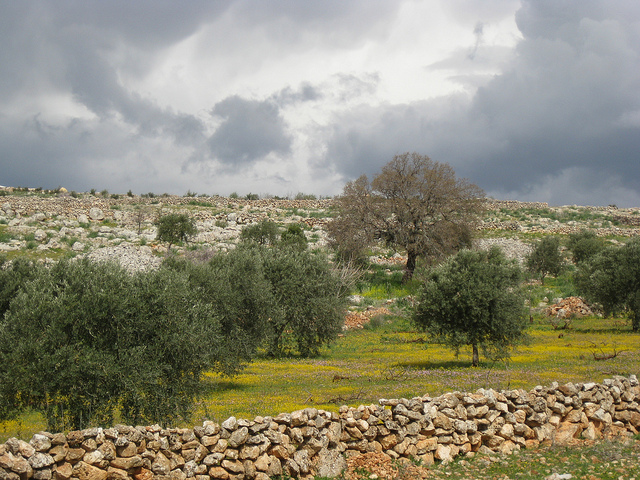
Landscape with olive trees and yellow flowers, Serjilla, Syria http://www.flickr.com
In the name of the Father and of the Son and of the Holy Spirit, one true God.
Glory be to Him; and may His grace and mercy be upon us for ever. Amen.
Holy, Holy, Holy, Lord God Almighty, by whose glory, the heaven and the earth are filled; Hosanna in the highest.
Blessed is He who has come, and is to come in the name of the Lord; glory be to Him in the highest.
(Prologue for daily prayer, Syriac Orthodox Church)
It is a wild and rainy day in Melbourne as I sit down to write this first post, God willing, of a new series – and the rain is fitting, because my poem for today takes inspiration from a hymn by 4th century poet and theologian, St Ephraim the Syrian, a prayer focused on the story of Noah.
O God of mercies Who didst refresh Noah, he too refreshed Thy mercies. He offered sacrifice and stayed the flood; he presented gifts and received the promise. With prayer and incense he propitiated Thee: with an oath and with the bow Thou wast gracious to him; so that if the flood should essay to hurt the earth, the bow should stretch itself over against it, to banish it away and hearten the earth. As Thou hast sworn peace so do Thou maintain it, and let Thy bow strive against Thy wrath!
Wrath is not a concept that our world likes to hear about, but in the context of Syria as it stands today the words seem to have a powerful immediacy. We can easily imagine Syrian believers today joining the congregation of Ephraim’s day responding to the priest with:
Stretch forth Thy bow against the flood, for lo! it has lifted up its waves against our walls!
As communities of Christian believers who have stood strong in Syria for nearly 2000 years leave their homes, possibly never to return, we need to stand with them in this prayer: a prayer for a land sorely besieged by the floods around it, desperately in need of our prayers and our solidarity with them.
In aid of this, and inspired by Johnnie Moore‘s call for the Western church to tell the stories of our Syrian brothers and sisters, I have decided to put together a series of poems structured around the ancient Syriac Orthodox daily prayers and the hymns of St Ephraim: an attempt to unearth some of the rich beauty of Syria’s Christian history, to remind us what is threatened, and what a powerful contribution the Syrian church has made to the Christian world.
So here is my first offering. I hope it might be a blessing to you as you read it today.
Damascus Road Prayers: Prologue
Father –
the bow is in the sky, but the floods fall still.
Our walls have stood, but now they totter.
The olive branches are wilting;
no doves fly here any more.
Father –
Noah turned away wrath with his prayer, with his sacrifice.
What hope does everlasting life hold for us? It reminds us that this present fallen world is not all there is; soon we will live with and enjoy God forever in the new city, in the new heaven and the new earth, where we will be fully and forever freed from all sin and will inhabit renewed, resurrection bodies in a renewed, restored creation. (New City Catechism)
No fall.
When the door swings out and, face-to-face we realise
all our clutching life could only mimic, never be,
we shall not fall
for all our walking here has been stumbling.
Now we stumble –
for who wouldn’t, when wandering in cloud?
Then we shall move
in the fluency of union,
fruit restored,
life itself again – no shadow –
and never will we grasp for knowing
that we are held
Of what advantage to us is Christ’s ascension? Christ physically ascended on our behalf, just as he came down to earth physically on our account, and he is now advocating for us in the presence of his Father, preparing a place for us, and also sends us his Spirit. (New City Catechism)
Not waiting in vain,
men and women thirsting at a cloudless sky,
nor farmers ploughing a desert.
Not children
hiding behind a veil of hands
or the clenched-fisted ones in the corner.
No metaphor sates us:
only a body will do. Only
face-to-face, Father to Son,
full sight in place of dim mirrors.
And so a body grows,
and for a body, a home with walls
solid to the touch, but never closed,
a welcome that has arms,
a priest who bears scars,
a love decked with nails,
crowned,
risen, no fall.
What does Christ’s resurrection mean for us? Christ triumphed over sin and death by being physically resurrected, so that all who trust in him are raised to new life in this world and to everlasting life in the world to come. Just as we will one day be resurrected, so this world will one day be restored. But those who do not trust in Christ will be raised to everlasting death. (New City Catechism)
And so, like the first fruits, He shows us what will be,
like the early fig I saw when winter had ravaged the tree:
hopeful, I return every day, expectant of the taste. So it is for the spirit.
Sometimes its workings are invisible
yet it is firm, this life which grabs you, arrests you.
Step out and see. Today is not like that first garden.
That day we clutched onto life that was not ours
This will not end. Though it linger, wait.
First you ate the fruit of death; now life’s fruit is on the tree.
You sow each day; tomorrow, reap
what life or death may bring.
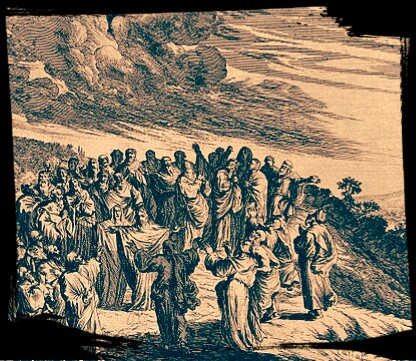
Detail from "Christ ascends to heaven before his disciples", Melchior Küssell
Where is Christ now? Christ rose bodily from the grave on the third day after his death and is seated at the right hand of the Father, ruling his kingdom and interceding for us, until he returns to judge and renew the whole world. (New City Catechism)
And where
if the body stands
is the head?
And where
if the family follows
is the leader?
No bad faith. Though we wait,
this is active:
for I have felt the hands,
though never touching skin, hold on,
and I have heard the voice (no sound)
speak my name and plead.
And I have seen these foes gather as one
united by a merciful head.
And I have heard heaven’s call say, Come up.
Though it tarry,
it won’t delay.
God chooses and preserves for himself a community elected for eternal life and united by faith, who love, follow, learn from, and worship God together. God sends out this community to proclaim the gospel and prefigure Christ’s kingdom by the quality of their life together and their love for one another. (New City Catechism)
Washed and waiting,
fed by Word, by bread, by Spirit –
a body, planned
from beginning, bought
by blood, crafted
by grace, grafted
by cross –
we wait, and show
the kingdom which stands
when nations fall, when bodies crushed
beneath the heel reveal the weight
of Now – we wait,
washed and purchased,
broken, glorious,
scattered, stained
and one.
Does the Lord’s Supper add anything to Christ’s atoning work? No, Christ died once for all. The Lord’s Supper is a covenant meal celebrating Christ’s atoning work; as it is also a means of strengthening our faith as we look to him, and a foretaste of the future feast. But those who take part with unrepentant hearts eat and drink judgment on themselves. (New City Catechism)
The feast awaits.
Now symbols and nutrients are divided,
vying for space in our minds.
The stomach craves what cannot sate spirit;
vine recalls dirt, bread anticipates yeast –
the work is done, the meal yet to be.
Take and eat. Eat and drink.
Bread cannot do what Spirit’s not done;
what bakes without yeast cannot rise.
Eat, recall; drink and trust:
what’s done has been done
and will prove true
when symbol and food can be one.





 The Consolations of Writing