Image: detail from Carl Bloch, “Sermon on the Mount”
Well, it’s high time that I got down to sharing with you some of the quite extraordinary poetry of former Archbishop of Canterbury, Rowan Williams. When Williams became Archbishop, many were unsure of his theology or what he stood for in his faith. Yet read his poetry and you see that, at heart, he is a poet: both a blessing and a curse, because poetry is full of nuance and complexity, something which can both aid and challenge our understanding of orthodox faith.
Today’s poem is based on Williams’ poem “Great Sabbath” (not readily available online, sadly, but you can view it here courtesy of Google Books). One of Williams’ gifts as a poet is his use of camouflage: the way that both his poetic form and the Biblical truths in his poetry creep up on you unexpected. So, to let my poem and his speak for themselves, I will say no more.
Now I tell you (After “Great Sabbath”)
Once before, they’d gathered by a peak
While gnats and flies buzzed around sore ears
And sun beat down on dull heads. It was a time
When mountain peaks had seemed too tall to climb
And law, they’d reasoned, must come to meet them here.
Yet law, tenacious, raised its voice to speak
In volumes which could never be ignored.
Higher than their ears could reach, it had come
Down to their dark, while scent of melted gold
And stink of drink and hot revelry turned cold
Lingered with them, and the righteous sun
Had blasted into every hidden store.
Today, the day at zenith, the sun burst
Across the bright-lit ridge where he stood.
Ears itched to hear his new-fangled thoughts:
Would he teach them a battle-cry? Sharp retorts
To put tyrants and bullies in their place for good?
The air rustled, scalps burned, and at first
They thought they heard familiar strains of songs
Taught at bedsides by mothers, aunts: that word, Blessed, a promise of no-one begging bread
And lands overflowing. (Milk and honey, they’d said.)
Today was dry; heat ate up much of what they heard.
Yet here and there a shock: cheeks turned toward wrongs,
The extra mile walked, the second tunic given.
Here, Simeon knew Eli still had his shirt
And Eli frowned when Enoch passed him by.
Hearts had excuses, but still the same reply:
A hand which rose to take in every hurt,
A back which gladly let itself be riven.
What, then, was blessing? A code? Sheer wordplay?
Some scratched their heads, others left for softer fare;
Some stayed, ears prickly, consciences seared.
Yet something of sheepish hope also appeared,
And as he paused, his lips a constant prayer,
He burnt their hearts with all his brightest day.
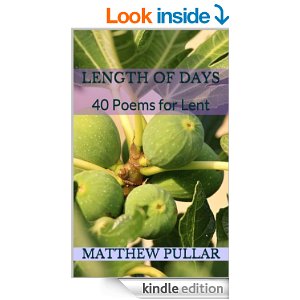
I’m pleased to announce that you can now purchase my sequence of Lent poems, “Length of Days: 40 Poems for Lent”, from the Amazon Kindle store. The book is the result of one of my first major poetry writing projects back in 2012, when I set myself the task of writing a poem a day throughout Lent. The poems that emerged from the project weave together the story of Jesus’ final week, from a variety of perspectives, with stories from the Old Testament. I hope and pray that these poems can be a helpful resource to others during this season.
What does God require in the fourth and fifth commandments?
Fourth, that on the Sabbath day we spend time in public and private worship of God, rest from routine employment, serve the Lord and others, and so anticipate the eternal Sabbath. Fifth, that we love and honour our father and our mother, submitting to their godly discipline and direction.