Uncovered Gems #2: Ruth Pitter

Last week I posted a poem in honour of Christina Rossetti, who I declared one of the Anglican church’s greatest literary exports. Today, in this week’s uncovering, I want to share with you the work of a widely forgotten gem, the Anglican poet Ruth Pitter. I have my friend Nathanael to thank for this discovery, a poet who is sometimes known as “the woman who should have married C.S. Lewis” (and who is widely recognised as a better poet than he ever was). She was also the first woman to receive the Queen’s Gold Medal for Poetry, alongside winning a number of other prestigious awards. And yet few have heard of her today. In fact, I only discovered her because my friend printed out some articles on her for me – and I’m very glad he did.

Pitter is not, perhaps, the sort of poet who will win many fans easily this century. Her verse is determinedly traditional. Her first book of poems (just called First Poems) has more references to fairies than are wholly to my liking (though she means it in the Tolkien or Neil Gaiman sense, not in the vein of Tinkerbell). But most of all, she is hard to get into today because her work is largely unavailable. You have to be willing to do a fair amount of your own work to discover her, and what incentive do you have if you’ve never heard of her?

Well, the purpose of this post is simply to make some of her work a little more readily available to those who are interested. Because, apart from the obstacles in our 21st-century way, Pitter deserves our attention. Her work is delicate, in a way that is both beautiful and illusive. It refuses to be pinned down, yet it is filled so often with a clearly sacramental imagination. For Pitter, the world is fleeting but points to lasting things. Darkness hurts yet is transfigured by day. Relationships are imperfect yet transfixed by irreducible grace.

One of the best clues to Pitter’s work for me came from this interview, in which she distinguishes between two types of obscurity: the “noble” obscurity in which the poem illuminates something unseen or unknown, and the “slovenly” obscurity that detracts from meaning without adding to it. Pitter’s best work feels like crystal-clear water, of a kind that perfectly allows us to see the rich complexities of the rivers’ floor beneath.

Here are just a few snippets of her work. I’ll let them speak for themselves.

And to finish, here is one of her most joy-filled offerings that I’ve found.
The Plain Facts

See what a charming smile I bring,
Which no one can resist;
For I have found a wondrous thing –
The Fact that I exist.

And I have found another, which
I now proceed to tell.
The world is so sublimely rich
That you exist as well.

Fact One is lovely, so is Two,
But O the best is Three:
The Fact that I can smile at you,
And you can smile at me.
The Language of Flowers: For Christina Rossetti

As an Anglican myself, I have to say that our literary exports don’t get much better than Christina Rossetti. Granted, she’s in formidable company, alongside George Herbert, John Donne, William Cowper, C.S. Lewis, T.S. Eliot and R.S. Thomas (why did you need to have the middle initial S in order to be a successful 20th-century Anglican poet?). Yet Rossetti is special for a bunch of reasons. She stands to this day as one of the most important female writers of her day – no small claim when you think of some of the writers she shared an era with – and has a remarkable balance of spiritual richness and honest as well as transcendental exploration of life that makes her successful not just as a writer of faith but also as a poet. She endured much in her life and produced poetry of only increasing beauty through that life, growing both in honesty and grace as a writer. It’s fitting, therefore, that she has a day in the Church of England calendar in her memory. It isn’t celebrated in the Anglican Church of Australia, but I can’t let a minor feast day for a beloved writer go by without writing something to honour it. So here is a poem in memory of an amazing woman, Anglican and poet.

The Language of Flowers

There it was,
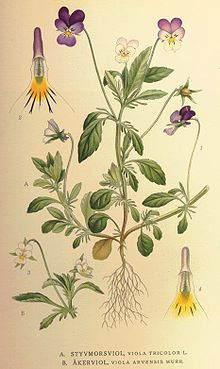
in your garden, amidst220px-Violatricolorarvensis.jpg
bleeding cyclamen, besides
burdened burdock and a trampled
patch of furze and hyacinth.

Ivy was torn
where you cut through the garden;
juniper drooped and lilac sank.
Yet, then you spied the valley lily
growing where it should not grow,
and a shock of eglantine.

Soft, you thought:
“I planted cyclamen to say,
I must wait. I gathered
burdock with its spines to say,
This is done. So go away.
I am done with artifice;
clematis I will rip from soil.
With dogwood, I am durable.
I cannot plant much else.”

Yet there it stood,
unplanted, unthought. When you went
to pluck a thorn to pierce
a puffed-up dream, you found instead
in varied purple-yellow-white
the heartsease for your sleep, and found
a day-bloom burst from night.

You had ripped
your palace down. There was no place
to lay your head but grass and weed.
Yet on that bed of purple light,
you dropped to rest your heart.

After Rosemary Dobson

Worn, I long for the simplicity of desert,
for Abba Poemen’s knee to rest my sleeping head.
I call to heart the peace of silent communion,
of neighbour and myself in essential speech.

But mind is Baroque in its impulse.
Chiaroscuro in substance, it curlicues toward ceilings,
rhizomatic and elaborate,
frantic in its downward and upward questing.

The finger outstretched, God to man,
is lost in my musing. Does it reach, nonetheless?
I seize this moment; possibility yawns.
At the foot of the morning’s cave, I listen.

Uncovered gems #1: Eleanor Spence, “Me and Jeshua”

“We’ll have follow-the-leader,” Jacob decided, “and Jeshua can be the leader.”
“No – you do it,” said Jeshua. “I like it better being last.”

(Eleanor Spence, Me and Jeshua, 1984)

Australian author Eleanor Spence has not been completely forgotten. Text Publishing recently reprinted her novel Lillipilly Hill as part of their Australian classics collection, and back in the 90s, she formed a reasonably large part of my primary school English education, with her books The October Child and The Leftovers both being prescribed texts. But her 1984 novel, Me and Jeshua, despite receiving quite a bit of critical acclaim, was last reprinted in 2001 and has all but completely vanished from the cultural memory.

When it came out, it was nominated for Children’s Book of the Year and, surprisingly for a mainstream author, won Christian Book of the Year for 1985. I found it in a collection of free books at the theological college where I study and, having heard of the author but not the book, was intrigued enough to take it home. And it has proven to be one of those forgotten gems that makes rummaging through old tattered books so worthwhile.

The story is written with that just-recognisable form of camouflage that allows familiar stories to become so fresh for the reader. Spence uses literal translations of all place names to make them, at first, hard to identify. Bethlehem, for instance, is called the House of Bread. And the characters of Jacob, Jude, Simon, Miriam, Josef, Elissa, Jona and, most importantly, Jeshua, take a few chapters to become familiar again to us as Jesus and his earthly family. The camouflage is aided by Spence taking the approach of making Jacob (James), Jude and Simon be Jeshua’s (Jesus’) cousins not brothers (a traditional Catholic view that allows Mary to remain a virgin after giving birth to Jesus). But, whatever reservations some readers might have with this take on the story, the rest is utterly plausible. Jude, the narrator, grows up hearing stories of his infamous but beloved aunt Miriam who conceived a child under scandalous circumstances but was married by the decent and generous Josef, and one day they return from a mysterious sojourn in Egypt to live with their family in what readers familiar with the Bible story will know to be Nazareth. Jude, learning who he is himself within his family and culture, is drawn more and more to this mysteriously wise, kind and altogether good cousin of his. Meanwhile, Jeshua must learn why he is so different to everyone else and what his true father wants him to be.

What arrested me so much about this novel was the beauty of the storytelling, influenced in no small part by the powers of Spence’s language and her evocation of place. Palestine is both palpably magical, with figs and fresh loaves you could almost pick off the page and eat, as well as torn apart by violence and poverty. Jude is a perfect narrator: aware enough of himself to be compassionate and imperfect at the same time. And Jeshua just shines: simultaneously an ordinary boy with fears and insecurities and yet good in a way that is never questioned or corrupted and – most remarkably of all – remains utterly credible.

I do not know what Spence’s personal conviction was about Jeshua the real, historical man. But in this remarkable, forgotten gem, she has made him human and glorious in a way that has drawn me anew to who He is.

Under Construction (Glenroy Lent: Maundy Thursday)

All night we pour out bitumen;
by day we mark out new lanes, construct
the avenues of better days,
the now-not-yet of our ways.

We close our eyes before the promised land;
passed over, we pass over the times
when paddock became mill became smelter.
Not done with the smelter yet, and yet

when the day is done, we wash our feet
after kneeling and washing
the paths for all feet. This new command
we half-receive as ash turns firm as clay.

Pink Cotton Promise (Glenroy Lent #10)

Even in new homes, morning has old narratives
formed by other mornings,
by schedules, by delays.

So I approach the day as though it’s been before,
as though
its parameters are fixed,

its possibilities known.
Adam beheld the first sunrise,
called himself inventor. I

almost ignore the miracle, too entangled
in strands of ground to see sky,
until

a scattering spool
of morning-pink cloud-thread
entwines my eye.

Not a word, as such,
but a message nonetheless,
a promise in this time of dust:

If this is how I hold the clouds,
then how much more…

And I am caught:

a moment between ash and new birth.
New Adam knows dust
and I am consoled in this knowledge.

Going Without (Glenroy Lent #9)

And so,
the first breath of autumn
hovering
above the freeway ramp, the breeze
has blown the top of a leafless tree,
all severed head, onto the road
where cars, eager to catch the green,
dodge that bunch of twigs and race.
I too have raced,
and now I race – in head, in heart.
The day begun, its chase in me,
I would be severed
from all that I’ve considered green
to see where I must rest.

At the Right Time (Glenroy Lent #8)

...the war he brought back with him is never far away in this suburb.
(Steven Carroll, The Gift of Speed)

Do you remember water from the rock?
How you quarried homes in this ancient soil,
when these broad meadows were the stuff of dreams?
Remember when the men came back
from years and years of wandering,
said, This is it, we’ll build it here,
and none of Egypt’s garlicked meat
could appetise their hearts away?

I was young. I don’t recall,
and was not there for much, or all.
But in the now, with homes all here,
the time is right to know again
what wilderness felt like.

Closed Til April (Glenroy Lent #7)

Nothing else open at this time,
only this one ageing witness to morning weakness.
Yet even the shop at the station’s closed –
“til April”, as though
the station itself were fasting.
In uncomfortable chairs, a man sleeps,
unlikely to remember the morning trains,
and outside the transit of ash to dawn,
a vermilion promise as the streets,
unaided by coffee,
slowly awake.

Avenue (Glenroy Lent #6)

What a discrepancy between
the joyful winging of birds
and the fear in men and women…

(Jean Vanier, The Broken Body)

And how one cricket starts
a neighbourhood symphony
in the grass of our roaming
near the concrete of our homing
in these streets and these footpaths
at a Friday-pink dusk

while the street in its silence
has houses and heartbeats
(through one window, hear dishes;
through another, hear Dickhead
be shouted – no reason);
and the moon in gauze sleeping
says, Here’s to a safe night,

watch over us, dusty
from the day, cool from night
watch our wandering, half-hoping,
half-asleep-on-the-job,
down these byways and laneways,
all these avenues of grace.