We travel through cosmic debris.
All the time a war wages – starshower missiles,
misguided asteroids.
The mayhem is our doing.
Harmony – meant to be sung –
ended with us.
Begin again with us.
From ashes we stand,
cupped hands opened to receive,
to re-enter Your orbit.
The heart seeks Tabernacle:
on mountain-top, by river-bank, it longs
to settle, to hold the Presence safe,
within arm’s reach,
just the length of an Elijah’s-staff away.
Yet the false Tabernacles we weave
as curtains against truth
turn Transfiguration to self-help session
and seek double portions to allay the moment’s loss.
Day turns to night.
The chariot leaves; the mountain calls us down.
Beneath the vision’s light, what will we know
when ecstasy fades and the presence evades
our attempts at tabernacles?
In the heart’s dwelling-place when the moment is past,
will we descend to today’s implications?
When the glow recedes but the portion remains,
will we tend to the horsemen of Israel?
Rembrandt van Rijn, “The Return of the Prodigal Son”, c.1661-1669
History has few exemplars to be proud of.
The Greeks did well with Priam, at least,
willing to face “iron-hearted,
man-slaying Achilles” for the sake of a son.
My own culture’s replete with absent men,
“bronze Anzacs” taught from birth not to cry.
The Biblical witness, too, leaves something to be desired:
most too busy with wives in multiples to see
sons ganging up on sons, hurling into ditches,
covering many-coloured garments with blood.
Some simply could not hear, over
the chewing of fruit, the sound of the older
saying to the younger brother, “Come for a walk.”
One king learnt too late that all
the years at war, or watching rooftop baths,
did not teach a son to trust or respect his old man.
Only this cry rings out as a lesson: “Absalom,
my son, my son! Would that it were me instead of you.
Absalom, my son, my son. Absalom, my son!”
Perhaps the polygamists, war-mongers and liars
have this to teach us: the insufficiency of one
man of dust to be the all, the end, of the home.
In his frailty and deceit he clears the way
for another tale, another sight:
the wealthy man embracing pig-stained rags,
the fattened calf killed,
the Father’s arms stretched.
This witness alone can teach the twisted tongue
the meaning of our faintly-voiced, “Father.”
At first darkness you saw it,
Light looming large on the horizon,
transfiguring and sanctifying all that it struck.
Yet you were drawn, contrariwise,
to a glistening object that,
no light of its own, could only reflect
or, at worst, refract.
Distracted by prismatic brilliance,
you answered the wrong call,
saw charisma and grabbed at it.
Only, Light denied you. Fistful of air,
you returned to your bedroom and sat
where only Light equipped to pierce darkness could reach. Okay, speak, you said reluctantly in the direction of the Light.
And so the Light began.
And so your life began.
Save me, O God: for the waters are entered even to my soul. I stick fast in the deep mire, where no stay is: I am come into deep waters, and the streams run over me.
(Psalm 69:1-2, 1599 Geneva Bible)
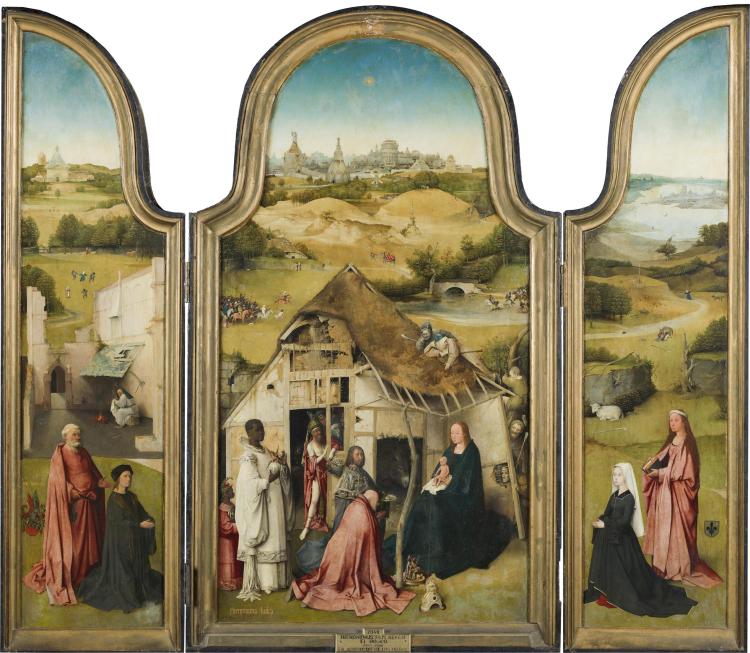
Is it, as Bosch would have it, a sinking scene,
hut scarcely erect, while in the background
knights and crusaders fight, and crazed faces peek
through cracks in the broken structure?
If so, my crazed face peeks.
Show me the truth through the falling thatch.
Let me climb to the roof to see
the light greater than the dark in me.
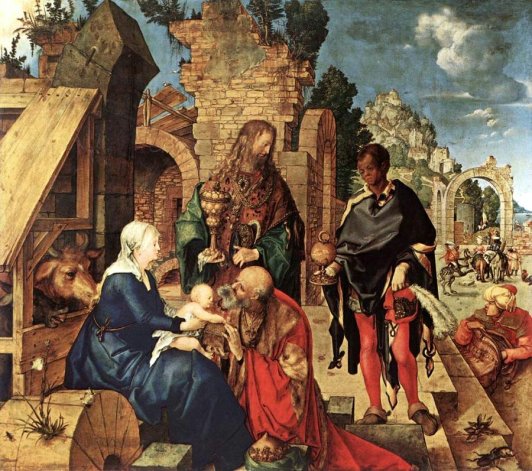
Albrecht Dürer, “Adoration of the Magi”, c.1504
Or, as for Dürer, does the Light lie in castle ruins?
Do relic-arches arc around the one who put
the promise-bow into the arching sky?
Do dark clouds gather on the edges? If so,
those clouds are me. O light eternal,
lighten the load the makes me droop and bristle.
I drown in the dry of my day.
Unwise, I come. Do not send my tattered folly away.
An error in the typeface, no doubt:
a missing space between God and swept,
as in, a wind from God
swept over the face of the waters.
Yet, in that mistaken instant,
my mind glimpses God sweeping,
baptismal waves enfolding me, Godswept, swept up in God.
Was it like this, at Jordan,
or at Ephesus, when
the new baptism, greater than John’s, was proclaimed?
Was the wind from God sweeping
as Ephesian believers
were swept up in new life,
new spirit, new wine?
Were the rammed-earth floors soaked
to the soil with that drenching?
Did the waves of God flood
through all their old toil?
O to be Godswept again and again,
to taste the salt, or the sand,
of Godwaters enclose.
Safe on the shore, I need to be Godswept.
May mistakes like this sweep
all my wisdom to sea.
“What can I give him,
Poor as I am?”
Christina Rossetti
Today is one of the most important days in the old church calendar, but also one of the most widely forgotten: the feast of Epiphany. Today we remember the wise men visiting Jesus, but we also remember what this represents, that the Gospel has been made known to the nations. Epiphany is an older celebration than Christmas, and in some early church documents it appears to have been the date when the Eastern church at least celebrated Jesus’ birthday. It’s a wonderful day, full of rich significance for believers to celebrate. Today we’re going to enlist one of my favourites, Bach, to see us through, with the help of his first Epiphany cantata. You can read the text and translation here.
Heartshine
I will arise with the stars.
In dappled light, the ground illuminates to show
the king made low,
the way made known.
I will arise with the stars to see
the glory that shines from east to west,
though wearing humble clothes.
I will arise with the night.
With nothing in my hand to give, I will receive
this treasure-trove
for years enclosed.
I will arise in the night to see
the light that day has not received
and now is bright to see.
I will travel with the kings
though I am no king, nor have ever been wise.
I will arise
with the stars in my eyes
and give a broken heart, for all
the better your treasure to store.
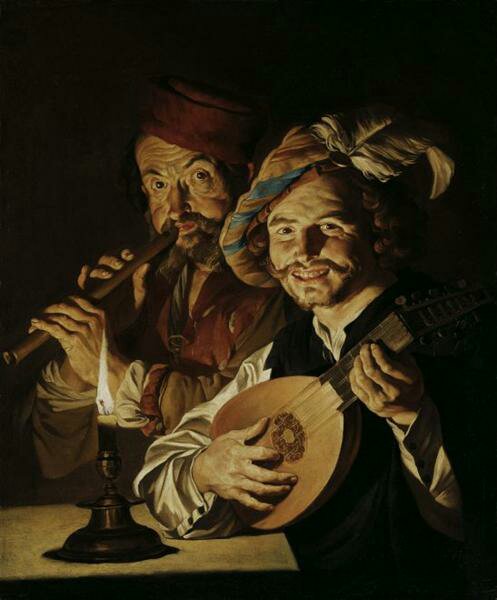
On this night in Shakespeare’s day, there would have been wild revelry to celebrate the twelfth night of Christmas. He even named one of his plays this, a sign perhaps that it was to be performed on the twelfth night, but also a possible nod to the ways that Christmas switches around our ideas of wisdom and foolishness, poverty and wealth. This same inversion is captured for me in the wondrously celebratory first movement of Bach’s Brandenburg Concerto No. 4, a piece which surprises listeners by placing the recorder, not usually a solo instrument, alongside the violin. It isn’t a Christmas carol in any sense, but I think it’s still a fitting conclusion to our early music Christmas season. It also works well as a soundtrack to one of our texts for today, Proverbs 22:2, which says, “The rich and poor meet together: the LORD is the maker of them.”
“The rich and poor meet together”
Hear this: it’s singing,
joyfully, stridently.
Nothing is as you have thought it to be.
Listen: the king is
enthroned, he is ruling.
Yet see how he rules, how he lays down his crown.
Watch this: the minstrels
sit at the king’s table.
See how the courtiers have no place to lounge.
Listen: recorders
are trilling in triumph.
Come to the feast! (Leave your privilege behind.)
Rembrandt, “The Flight into Egypt: a night piece”, from a print made by Henri Louis Basan, c. 1810
One of the more curious lost phenomena of Christmas was the late Medieval custom of appointing a so-called “Lord of Misrule” (or, as called in Scotland, the “Abbot of Unreason”). This involved either a peasant or an unimportant figure in the church being appointed to oversee the Christmas revelries. A related or parallel custom involved appointing a “boy bishop”, a child who would be bishop for the duration of the Christmas season. The “misrule” over which the Lord of Misrule ruled was sufficiently baudy that the Protestant Tudor rulers, as part of their cleaning up of the English church, saw fit to abolish the custom (although the Catholic Tudor, Mary I, saw fit to reinstate it). Yet there’s an unexpected biblical truth contained in the custom: that human rule is turned upside down by the coming of a baby king into the world who, though born a peasant, was God Himself.
As we approach Epiphany (this Saturday), the daily readings remind us of the ways that the wisdom of the world is different to the wisdom of God (expressed by the wise men finding the heavenly king not with Herod but in peasant Bethlehem). Today’s poem takes as its inspiration the rollicking Medieval song, “Lux Hodie, Orientus Partibus”, a joyful song about a powerful donkey carrying a king. It’s in these kinds of moments that I think the Medieval church remembered something about the truth of Christmas that we would do well to remember today.
Upsidedown
You who would be wise, take heed:
the king lies in a peasant’s bed.
You who would be great, take heed:
He takes a donkey as His steed.
You who would follow Him, take heed:
His throne’s a cross, a cursed tree.
You who would find life, take heed:
true life must die first, as a seed.
You who would be wise, take heed:
most blessed is this bruised reed.
Caravaggio, “Nativity with St Francis and St Lawrence”, 1609.
“The LORD says to my Lord…” (Psalm 110:1). These are surely some of the more mysterious words to appear in the Bible. Who is the second Lord to whom the writer, King David, is referring? Who could even be understood to be David’s Lord apart from God, the LORD? David, after all, was king of all Israel; no-one beside God was higher than him. And yet he looks to another Lord who will be made king over everything and who, mysteriously, will also be a priest forever too. In Jesus, the mystery is, if not resolved, at least given flesh so we can behold it.
Today’s piece is Vivaldi’s powerful setting of Psalm 110, entitled “Dixit Dominus” (“The LORD says”) after the first two Latin words in the psalm. I’ve chosen Caravaggio’s strange Nativity scene, which anachronistically features Saints Francis and Lawrence, to help us to reflect on the wonder that this mighty king chose to come as a tiny baby. Caravaggio’s famous chiaroscuro lighting manages to hihglight Jesus’ face without resorting to the artistic cliches of his day. The presence of two saints known for their love of the poor seems fitting for this simple, peasant scene into which the king of all creation chose to come to earth.
Sit at my right hand
All earth is your footstool;
soon so will your enemies be too.
Yet You sit at our feet, minuscule, helpless,
Creator on the floor of creation,
infinite made finite,
the dew of your youth around you on the hay.
Judge of the nations: the nations come
to see your defenseless form, to catch
the future glory in your minute moment.
Where is your sceptre? You drink
from your mother’s breast; cannot
yet lift your head, nor fight.
Await the voice: “Sit at my right hand.”
But first you will cry, “I thirst”,
and, “It is finished,” and, “My God,
my God, why?” Heaven surrounds you,
but first the sword and the nails.
First the manger, this moment in eternity’s grasp.





 The Consolations of Writing
#/media/File:Hieronymus_Bosch_-_Triptych_of_the_Adoration_of_the_Magi_-_WGA2606.jpg)